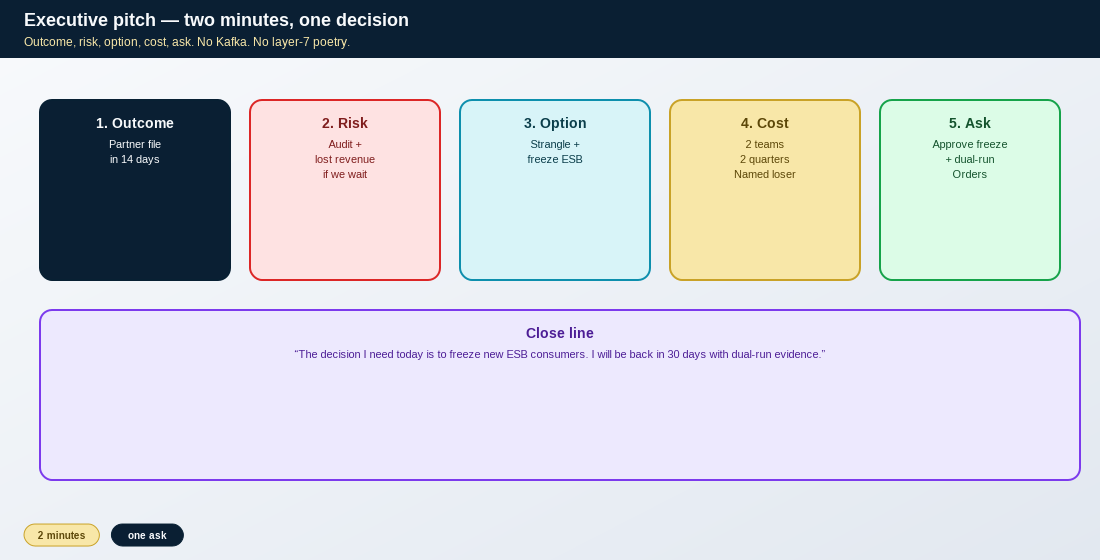
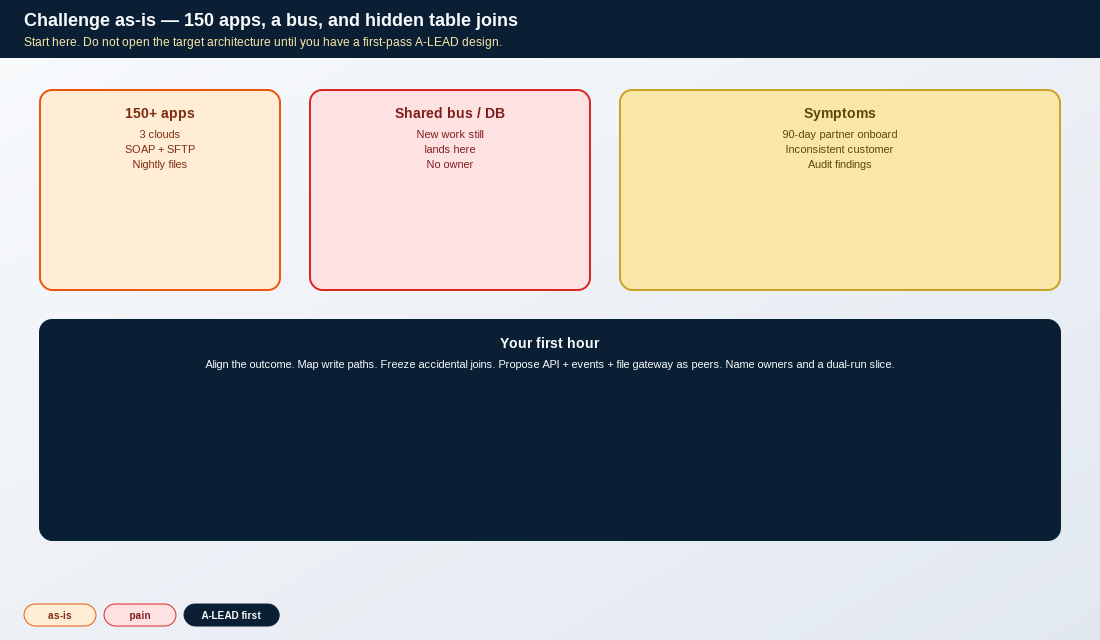
Q-001 · Architecture Strategy · principal
Three business units independently created customer-profile services. Data is inconsistent and each team wants to retain ownership. As Principal Architect, what do you do first?
BayLearn Weekend Interview Sprints
Senior Architecture Interviews Test Judgment, Not Vocabulary.
Practice ambiguity, enterprise trade-offs, architecture evolution, risk, leadership, influence, and executive communication.
Not sure if this is the right Sprint? Start with the assessment.
Refund terms are drafted and are not a current offer. Refund policy
Live 1:1 is $499. Introductory live 1:1 is $449 — a configured price, not a countdown.
Best fit: You already lead design conversations and need to show judgment, influence, and trade-offs out loud.
Not ideal: You want an introduction to software architecture vocabulary.
Hour 1
Core concepts and interview patterns
Hour 2
Architecture / coding scenarios
Hour 3
Hands-on interview challenges
Hour 4
Mock interview and feedback
Can you explain these confidently?
Himanshu Bhadra
Enterprise Architect | Cloud | AI | Distributed Systems | Technical Leadership
Learn by designing, building and explaining.
Private 1:1 · Book on request
Private 1:1 sessions are scheduled after you book. No public cohort dates are listed yet.
Formats: Group Sprint and Private 1:1 Sprint when scheduled.
Book a Free 15-Minute Interview Strategy CallProfessional Programs are 8–16 week paths with labs and capstones. Use a Sprint to get interview-ready, then a program if you need deeper mastery.
Explore Professional ProgramsDraft refund policy. Not a current offer.
Short lessons in interview order. Architecture workspaces run in the player — BayLearn does not invent candidate experience.
You will
Course overview5 min
Course overview
You are here to practice framing an estate, leading the design, and defending the call.
This sprint is four hours of interview prep. When you leave, you should be able to frame an enterprise problem, design an architecture that can evolve, weigh alternatives, handle technical risk, get more than one team aligned, defend the decision, and explain it to executives.
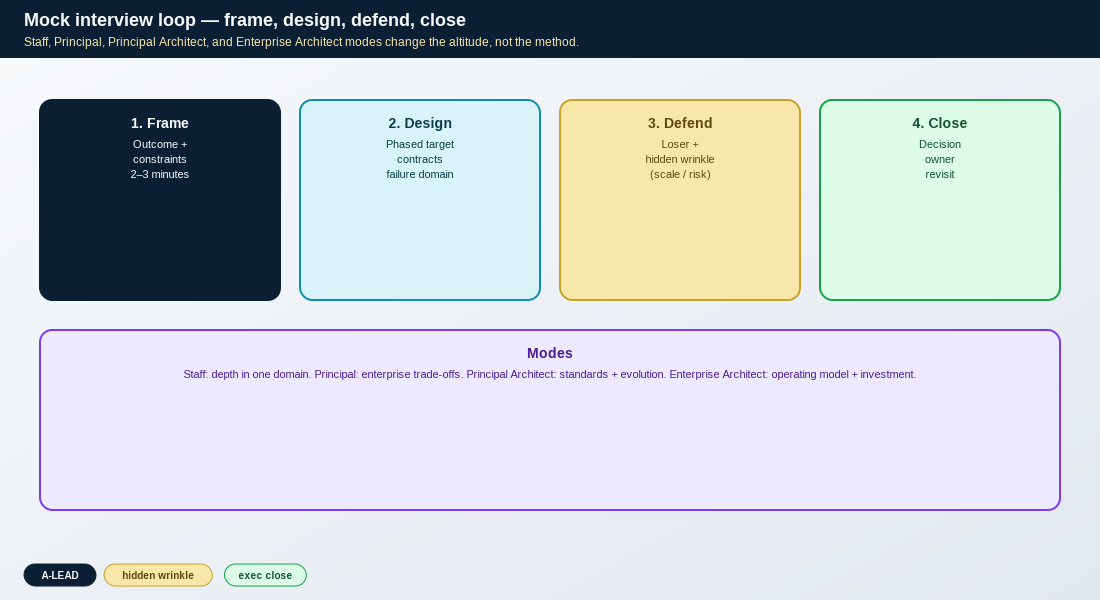
The method is A-LEAD: Align on Outcomes, Learn Constraints & Landscape, Establish Architecture & Evolution, Analyze Trade-offs & Risks, Drive Alignment & Decisions. If you skip Align and Learn and start with Kafka, you can lose even if every box looks “correct.”
Each module has a short overview and one or more deep-dive lessons. Read the overview, then open the lesson — do not stop at the stub.
| Module | Deep-dive lessons |
|---|---|
| 0 Readiness | how-the-assessment-works |
| 1 A-LEAD | a-lead, align-outcomes, learn-landscape, establish-architecture, analyze-tradeoffs, drive-alignment |
| 2 Enterprise architecture | enterprise-layers, architecture-principles, architecture-styles |
| 3 Distributed / integration / platform | distributed-systems, integration-matrix, api-governance, data-ownership, reliability-dr |
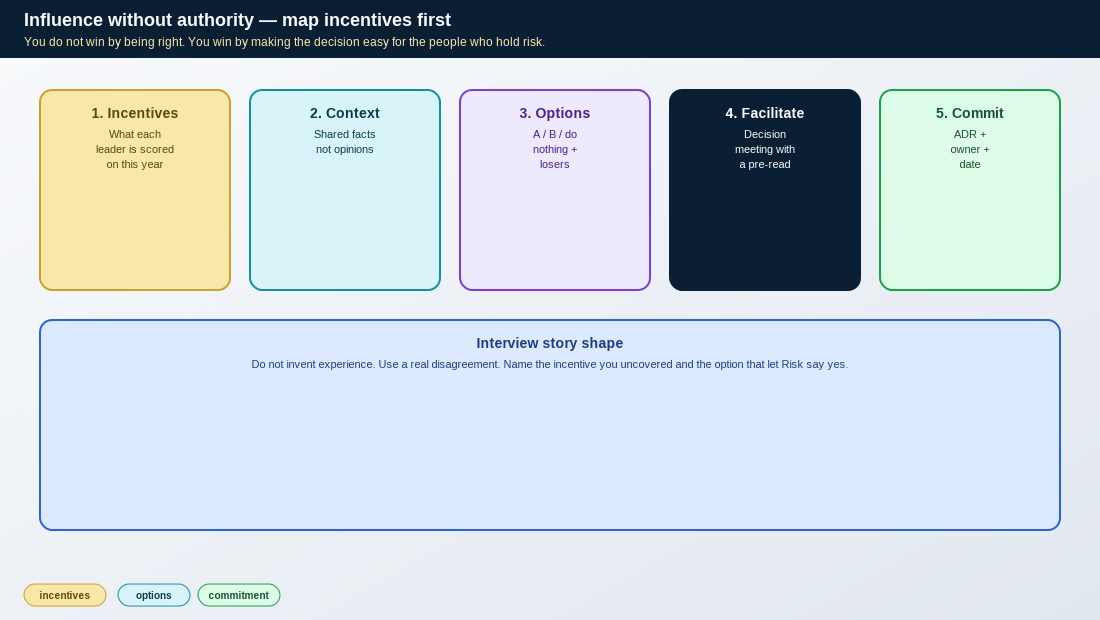
| 4 Leadership | influence, star-a, executive-pitch |
| 5 Challenge | enterprise-challenge — as-is first; target hidden until you attempt |
| 6 Mock | mock-brief — modes STAFF_ENGINEER, PRINCIPAL_ENGINEER, PRINCIPAL_ARCHITECT, ENTERPRISE_ARCHITECT |
| 7 Feedback | feedback-plan |
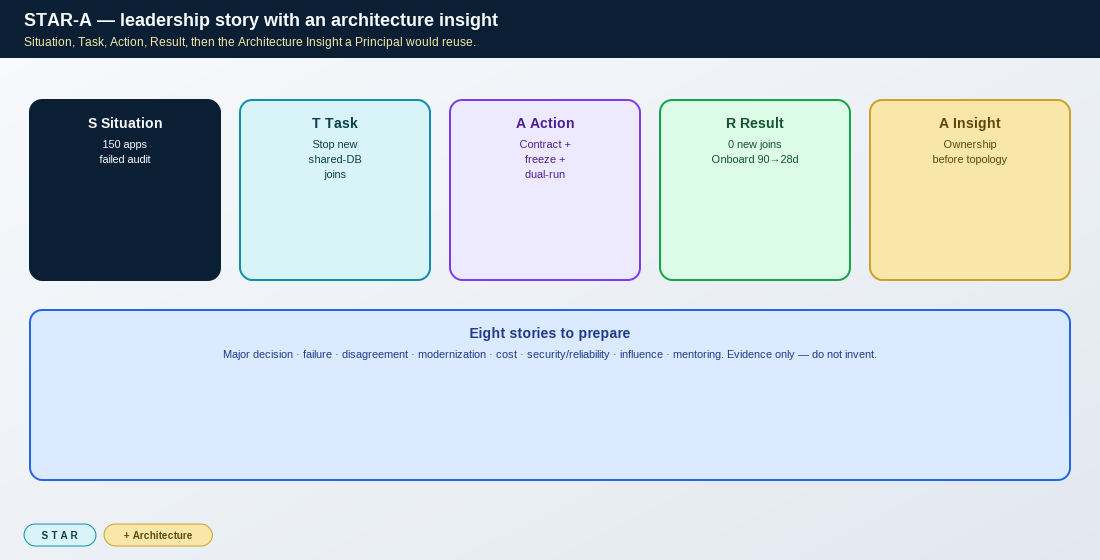
STAR-A means Situation, Task, Action, Result, Architecture Insight. Prepare evidence from work you did. Do not invent candidate experience.
The mock score is rehearsal against a published rubric. It is not a hiring prediction. The certificate is a BayLearn Certificate of Completion, not a license and not a professional accreditation.
Take Module 0 before you grind the question bank. Learn A-LEAD before you draw. Attempt the challenge before you open the hidden target. Confirm the mock mode before you claim enterprise scope. Treat Module 7 as a map of what to rehearse for seven days, not as a trophy band.
Deep-dives for leadership, challenge, mock, and feedback are the files this sprint expects you to rehearse out loud: influence, star-a, executive-pitch, enterprise-challenge, mock-brief, feedback-plan. Module overviews are maps, not substitutes.
INTERVIEW TIP: “Before I start designing, I want to align on the business outcome and the constraints I must not violate.”
Start here
Start here
You are here to practice framing an estate, leading the design, and defending the call.
This sprint is four hours of interview prep. When you leave, you should be able to frame an enterprise problem, design an architecture that can evolve, weigh alternatives, handle technical risk, get more than one team aligned, defend the decision, and explain it to executives.
The method is A-LEAD. Leadership stories use STAR-A (Situation, Task, Action, Result, Architecture Insight). Prepare evidence from work you did. Do not invent candidate experience.
Each module overview is a thesis and a map. The scored teaching lives in the deep-dive lessons:
| Module | Overview | Deep-dive lessons (lessons/) |
|---|---|---|
| 0 | module-0.md | how-the-assessment-works.md |
| 1 | module-1.md | a-lead.md, align-outcomes.md, learn-landscape.md, establish-architecture.md, analyze-tradeoffs.md, drive-alignment.md |
| 2 | module-2.md | enterprise-layers.md, architecture-principles.md, architecture-styles.md |
| 3 | module-3.md | distributed-systems.md, integration-matrix.md, api-governance.md, data-ownership.md, reliability-dr.md |
| 4 | module-4.md | influence.md, star-a.md, executive-pitch.md |
| 5 | module-5.md | enterprise-challenge.md — as-is first; 19-challenge-target.svg stays hidden until a first attempt |
| 6 | module-6.md | mock-brief.md — modes STAFF_ENGINEER, PRINCIPAL_ENGINEER, PRINCIPAL_ARCHITECT, ENTERPRISE_ARCHITECT |
| 7 | module-7.md | feedback-plan.md |
Player copies of the same deep-dives live under course-ui/content/lessons/. Package copies live under lessons/ in this course folder.
Mock scores and readiness bands are rehearsal diagnostics. They do not predict hiring. The certificate is completion, not accreditation.
INTERVIEW TIP: “Before I start designing, I want to align on the business outcome and the constraints I must not violate.”
You will
How the assessment works8 min
How the assessment works
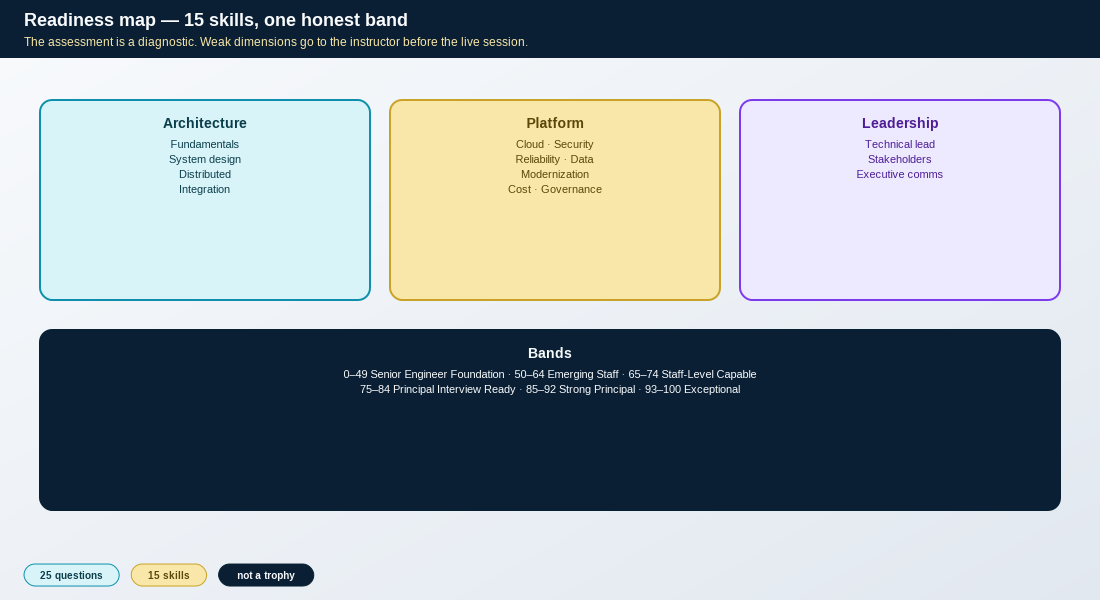
In one sentence: The 25-question assessment is a diagnostic of interview readiness across 15 skills — it routes your sprint; it does not predict a hire.
A Principal / Staff Architect loop does not grade a trivia percentage. It grades whether you can frame an estate, pick a first slice, and defend a decision when a VP interrupts. The BayAreaLa8s Team built this assessment to surface the same failure modes: drawing a gateway before an outcome, naming a broker before an owner, and treating consistency as “CAP — pick two.”
Take it before you grind the 220-question bank. If you study first, you teach the multiple-choice, not the interview. The number is a routing tool for the instructor and for you: weak dimensions go to the live session; strong ones get follow-ups, not a victory lap.
Read the diagram, then say: I am not hunting a trophy score. I want the two skills that would fail a 45-minute estate design, and I will drill those before the mock.
Twenty-five scenario questions map to four interview surfaces: architecture, integration, leadership, and executive communication. The skill list is fifteen items, grouped the way a debrief sheet is grouped.
| Cluster | Skills the items actually poke | What a miss sounds like in the room |
|---|---|---|
| Architecture | Fundamentals, system design, distributed systems, integration | Boxes first; no owner; no coexistence plan |
| Platform | Cloud, security, reliability, data, modernization, cost, governance | Vendor as strategy; big-bang cutover; no SLO |
| Leadership | Technical lead, stakeholders, executive communication | Slack consensus; 40-option deck; no close |
Bands are interview readiness, not hiring predictions. The BayAreaLa8s Team will not tell you that a 78 means an offer.
| Score | Band | What to do this weekend |
|---|---|---|
| 0–49 | Senior Engineer Foundation | Stay on A-LEAD. Do not skip to Kafka diagrams. |
| 50–64 | Emerging Staff | You can design a service. Drill outcomes, owners, and evolution. |
| 65–74 | Staff-Level Capable | Definitions are fine. Risk is follow-ups and the close. |
| 75–84 | Principal Interview Ready | Practice interruption: “Legal needs one Golden Customer.” |
| 85–92 | Strong Principal | We will add a hidden constraint mid-whiteboard. |
| 93–100 | Exceptional | Spend time on executive pitch and the mock, not retakes. |
How to sit the assessment:
Use the report as a bug list. Circle two skills. Those become spoken drills: 90-second whiteboard, then a five-sentence close a sponsor can repeat.
What the items look like in practice:
The 220-question bank is for after the map exists. Use it to rehearse follow-ups on your two red skills, not to reverse-engineer Module 0. If you sit the assessment twice in one evening, you are measuring recall of the options, not readiness.
Bring the BayAreaLa8s Team instructor a hypothesis, not a plea: which cluster will fail first, and which spoken drill you will run before the mock. That is how a Principal uses a diagnostic.
Open the debrief the way you would open a design review:
“This score is interview readiness, not a hiring prediction. My weak cluster is data ownership and executive close. I will not start the mock by drawing a bus.”
When an item is about three customer-profile services:
“Inconsistency is a business cost first. I will map who writes which fields and who pays when they disagree before I pick a store or a vendor.”
When the VP says “draw the target”:
“I will time-box two or three outcomes and current-state risks, then propose a phased target — not a complete redraw of 150 apps.”
| Senior Engineer reflex | Principal move |
|---|---|
| Retake until the percentage looks senior | Treat one sitting as a bug report; drill the two red skills |
| Ask the instructor “am I ready to apply?” | Bring a hypothesis: “I will fail if they ask who owns KYC fields.” |
| Study the 220-bank first to “be fair to myself” | Take Module 0 cold so the map is honest |
| Treat 75 as a trophy | Treat 75 as “ready to be interrupted,” not “done” |
| Blame cloud or Java gaps for a leadership miss | Leadership items fail when you cannot close a decision |
A 150-app payments estate: SOAP, overnight partner files, three clouds, three customer-profile services. You scored 61 (Emerging Staff) with misses on data ownership, modernization, and executive communication. In eight minutes, write the two drills you will run before the mock, and the one sentence you will say to the BayAreaLa8s Team instructor about what will fail first.
INTERVIEW TIP: Answer from first principles. The assessment is a diagnostic — take it cold, then spend the sprint on the two skills that would stop the room, not on polishing the number.
Readiness Assessment15 min
Readiness Assessment
Take this before you grind the 220-question bank. I want a map of weak dimensions, not a trophy score. Fifteen minutes. Twenty-five scenario questions. Answer from first principles.
The map clusters Architecture (fundamentals, system design, distributed, integration), Platform (cloud, security, reliability, data, modernization, cost, governance), and Leadership (technical lead, stakeholders, executive communication). One honest band is enough. Re-taking until the number looks pretty is not the module.
Twenty-five scenario questions across architecture fundamentals, system design, distributed systems, integration, cloud, security, reliability, data, platform thinking, modernization, cost, governance, technical leadership, stakeholder management, and executive communication.
| Score | Label |
|---|---|
| 0–49 | Senior Engineer Foundation |
| 50–64 | Emerging Staff |
| 65–74 | Staff-Level Capable |
| 75–84 | Principal Interview Ready |
| 85–92 | Strong Principal |
| 93–100 | Exceptional |
A Foundation score is not a fail. It tells the instructor where the live session should spend time. Exceptional is rare. This score does not predict a hiring outcome.
Use the result to choose which Module 1–4 deep-dives you repeat. Do not skip A-LEAD because the architecture cluster looked strong. Framing is a separate skill.
Sit as if this were the first fifteen minutes of a loop. No second tab. No “I would look that up.” If you do not know a number, say the principle and the trade-off. The instructor uses weak dimensions to aim the live session; a silent 80 with guessed answers wastes that time.
After you finish, write three words: weakest architecture skill, weakest platform skill, weakest leadership skill. Carry those into Module 1. Module 7 will update the same map after the mock.
This assessment is not the 220-question bank and not the final. It is the diagnostic you take first so you do not grind the wrong chapter.
NOTE: This score does not predict a hiring outcome.
INTERVIEW TIP: Answer from first principles. Do not open another tab to confirm.
25 scenario questions. Each card is tagged with the skill it scores. Open a card to read the prompt and the four choices.
Scored take: enroll, open Learn, then this same lesson. One question at a time. After 15 you see your band and eight skill scores.
You will
A-LEAD8 min
A-LEAD
In one sentence: A-LEAD is the spoken method for a Principal interview — Align, Learn, Establish, Analyze, Drive — and if you skip Align and Learn and start with a broker, you lose even if every box is “correct.”
Staff interviews reward a clean service diagram. Principal interviews reward a method the room can follow when the estate is 150 applications, an ESB still taking new work, and three units fighting over customer profile ownership. Interviewers are not scoring TOGAF vocabulary. They want to see whether you can scope a 45-minute problem, refuse a pattern catalog, and close a fundable decision.
A-LEAD is sequential on purpose. You cannot analyze trade-offs you have not established, and you cannot establish an architecture you have not learned. Naming Kafka, Kubernetes, or a cloud bus in sentence one is the anti-pattern this sprint trains out.
Read the diagram, then say: Before I draw, I align on the outcome and the constraints I must not violate. Then I time-box the landscape and propose a phased target.
| Letter | Move | What you put on the board | You will be stopped if… |
|---|---|---|---|
| A Align | Outcome, stakeholders, success, timeline, cost of failure | One sentence the sponsor can repeat | You name a broker before an outcome |
| L Learn | Systems, teams/skills, regulation, legacy, vendors | Write paths and accidental joins | You inventory only the preferred cloud |
| E Establish | Target + phases, boundaries, integration, migration | Now / next 90 days / later | You have only an end-state poster |
| A Analyze | Winner, what you give up, risks, operability, org impact | What you give up + revisit trigger | You cannot say what you are not doing |
| D Drive | Decision, owners, metrics, ADR | A close a VP can fund | No owner for the contract |
Time-box a 45-minute loop like a Principal, not like a catalog:
Enterprise running example you will reuse all weekend: a payments and partner-file estate. The ESB still lands new work. Sales, Risk, and Ops each “own” customer profile. Partner onboarding is measured in weeks. A-LEAD does not start with “replace the ESB with events on AWS.” It starts with time-to-first-production-file and the cost of a failed KYC match.
Do not invent a personal war story. Use the scenario the interviewer gave you. The method is the same whether the constraint is residency, a union skill mix, or a vendor contract you cannot break this year.
Narrate the letter you are in. Interviewers can follow “I am still in Learn — two more write-path questions” and they cannot follow a silent jump from Kafka to Kubernetes. If they interrupt with a hidden constraint (Legal needs one Golden Customer), do not restart the drawing. Re-Align the outcome that just changed, then patch Learn and Establish.
A-LEAD is not R-SCALE, D-SCALE, or a TOGAF phase list. You will not be scored on framework trivia. You will be scored on whether the room hears a method: frame, constrain, propose a phased target, say what you give up, close.
Five-minute warning rule: if the target is “good enough” and Drive is empty, stop drawing. A sponsor-repeatable decision with a sketched component beats a complete catalog with no owner.
What each letter refuses:
If you skip a letter, do not pretend you did it. Say “I skipped Learn on skills — flag that as a risk” and keep moving. Honesty about a missing constraint is a Principal move. Inventing a landscape you were not given is not.
Open the room before the marker hits the board:
“Before I draw, I want to align on the outcome and the constraints I must not violate. Then I will time-box the landscape and propose a phased target.”
If they push “just draw”:
“I can sketch a target in two minutes, but it will be a pattern catalog. Give me four minutes on outcome and cost of failure so the boxes mean something.”
If you hear yourself saying a product name:
“I am not picking a broker yet. I am deciding whether this hop needs a contract, a file, or a sync call — then I will name an example implementation.”
When time is almost gone:
“I am moving to Drive. Decision, two rejected alternatives, owner, metric, revisit. I will leave the mesh undrawn.”
| Senior Engineer reflex | Principal move |
|---|---|
| Start with Kafka / Kubernetes / a mesh because “that is modern” | Start with outcome, owner, and the constraint you will not violate |
| Design the five-year end state, then “we’ll migrate somehow” | Establish now / next / later with a reversible first slice |
| Compare tools before constraints | Learn write paths, skills, and vendors before topology |
| Spend the last five minutes adding boxes | Drive: decision, risks, owners, one metric the sponsor can repeat |
| Treat A-LEAD as a slide title | Narrate which letter you are in so the interviewer can follow |
Interviewer: “Design the target architecture for our 150-app estate. SOAP, SFTP, three clouds. You have 45 minutes.” Do not draw a gateway. Speak the first 90 seconds of A-LEAD: the outcome you will confirm, the two landscape questions you will ask, and the sentence that keeps you from naming a broker.
INTERVIEW TIP: “Before I start designing, I want to align on the business outcome and the constraints I must not violate.” Say it out loud. The framework is A-LEAD, not a pattern catalog.
Align on Outcomes5 min
Align on Outcomes
In one sentence: Align is five questions before a box — outcome, stakeholders, success, timeline, and cost of failure — so a 150-app “draw the target” prompt becomes a scoped problem a Principal can finish in 45 minutes.
A VP who says “draw the target” is testing whether you can refuse an unbounded estate. Senior engineers hear a drawing request. Principals hear a scoping test. If you optimize the ESB, pick a cloud region, or buy MDM before you know which customer outcomes break, you have started a product evaluation, not an architecture interview.
Interviewers listen to the sentence you write at the top of the board. If that sentence is a technology, the rest of the hour is recovery. If that sentence is a business result with an owner and a date, they will let you design.
Read the diagram, then say: The outcome I am designing for is partner time-to-first-production-file. I will not optimize the ESB unless that number moves.
Ask these five, in this order. Write the answers. Do not keep them in your head.
| Question | What you are extracting | Estate example |
|---|---|---|
| What business outcome? | A result, not a platform | Partner onboarded to first production file in 14 days |
| Who are the stakeholders? | Who can stop or fund the work | COO, Risk, Partner ops — not “IT” |
| What does success look like? | An observable, not a vibe | First file in prod without a war room |
| What is the timeline? | This fiscal year vs a rewrite | A reversible slice this quarter, not a 5-year replatform |
| What is the cost of failure? | Who pays in money, risk, or audit | Lost partner revenue plus audit findings on KYC mismatch |
Write this block on the board before any gateway:
text
Outcome · Owner · Metric · Date
Constraint I will not violate
What is out of scope this hour
Out of scope is a Principal tool. In 45 minutes you cannot redesign 150 apps, three clouds, and every SOAP endpoint. You can pick the two or three outcomes that matter this year and the seams that block them: partner files, customer profile disagreement, new work still landing on the ESB.
When three units own overlapping customer data, do not ask which region the golden record should live in. Ask which customer outcomes break today because the data disagrees, and who pays when they break. Legal may need one Golden Customer for KYC while Sales will not surrender CRM fields. That split is an Align fact. The store comes later.
Cost of failure keeps you honest. If a missed partner SLA is a contractual penalty, you will not spend the hour on a five-year event backbone. If the failure is a silent KYC miss, you will not “let each team keep its service and overwrite nightly.” Nightly overwrite is not an outcome; it is a new unowned source of truth.
Vendor-neutral from the first minute. If someone says “we are an AWS shop,” treat that as a constraint to Learn, not as the outcome. The outcome is still time-to-file, consistency of profile, or auditability.
A useful Align sentence has four parts you can point at:
If any part is missing, you are still in Align. Do not “save time” by drawing while you think. The VP who said “just draw” is scoring whether you can hold the room for four minutes. Two or three outcomes is enough. A list of twelve OKRs is another pattern catalog.
When the room offers a technology as the goal — “we need events,” “we need a mesh,” “we need to be on one cloud” — translate it back. Events are a candidate hop. A mesh is a delivery choice. One cloud may be a constraint. None of those is the business result.
Align is also a cut. If partner time-to-file is the outcome, you will not spend the hour redesigning the data lake. Say that. Interviewers relax when they see you protect the hour. Write the cut on the board so it is a decision, not a vibe.
“The outcome I am designing for is partner time-to-first-production-file. I will not optimize the ESB unless that number moves.”
“Who owns the metric, and who pays if the first production file fails? I need COO, Risk, and Partner ops on the same sentence.”
“Success is first file in prod without a war room — not ‘we stood up a bus.’ Timeline is this fiscal year. Five-year rewrite is out of scope this hour.”
“If we fail, we lose partner revenue and pick up audit findings. That is the cost I am designing against.”
“Data lake and mesh are out of scope this hour. I am protecting the 45 minutes for partner files and customer-profile ownership.”
| Senior Engineer reflex | Principal move |
|---|---|
| Hear “draw” and start a gateway / lake / mesh | Hear “draw” and spend four minutes on outcome and cost |
| Treat “modernize the ESB” as the outcome | Ask which business number the ESB is blocking |
| Optimize for the loudest team’s stack | Name the stakeholder who funds and the one who can veto |
| Accept “success = microservices” | Demand an observable: file, match-rate, war-room count |
| Leave timeline implicit | Say what is in this quarter vs later, out loud |
A VP opens: “We have 150 applications, SOAP, SFTP, and three clouds. Draw the target architecture.” Sales, Risk, and Ops each run a customer-profile service. Partner onboarding takes six weeks. You have four minutes. Speak Align only: outcome, stakeholders, success, timeline, cost of failure, and what you will not design this hour.
INTERVIEW TIP: Write Outcome · Owner · Metric · Date before the first box. If you cannot say who pays when partner files or customer profiles fail, you are not ready to draw.
Learn Constraints & Landscape5 min
Learn Constraints & Landscape
In one sentence: Learn is a time-boxed socio-technical survey — systems, write paths, owners, regulation, skills, vendors, and hidden joins — because those constraints *are* the design, not a footnote after the topology.
A Senior inventory is the stack: language, cloud, queue. What I want from you is who may write a customer, who operates the overnight file, and which table join nobody sanctioned. If your target ignores union skills, PCI, residency, or a vendor you cannot exit this year, you have a slide, not a decision.
Interviewers listen for whether you treat 150 apps as a box-drawing problem or as a landscape of write paths. They also listen for operational maturity: a beautiful event backbone with no one to own poison messages is not architecture.
Read the diagram, then say: I will time-box current-state risks — unowned data, point-to-point, missing SLOs — then propose a phased target.
Probe this list before you propose a target. Stack and preferred cloud are necessary and not sufficient.
| Probe | What you need to hear | Typical estate fact |
|---|---|---|
| Existing systems | How work actually moves | 150 apps, SOAP, SFTP, three clouds, ESB still taking new flows |
| Write paths | Who creates customer, order, payment | Three profile services; nightly overwrite of a shared table |
| Owners | Product, Risk, Ops, vendor | Risk owns KYC fields; Sales will not give up CRM |
| Teams and skills | Who can run what you draw | File operators, not a platform team for a log |
| Regulation / security | Invariants you must not violate | PCI, data residency, audit retention |
| Data | Contracts vs accidental coupling | Shared customer tables; no field-level owner |
| Vendors / budget | Commitments you cannot wish away | ESB license, partner file formats, one cloud as *an* example |
| Operational maturity | On-call, SLOs, poison, DR | No SLO on partner file; war rooms are the process |
| Legacy dependencies | What cannot move this quarter | Core SOAP services; batch windows |
The interview artifact is a 2×2, not a CMDB:
text
                  Sanctioned contract     Accidental coupling
Write path        API / file / event      Shared table, nightly overwrite
Read path         Owned query / replica   Cross-schema join nobody owns
Freeze new table access as a spoken control. You do not need a six-month discovery. In eight minutes you name the three hottest risks that would kill a target: unowned customer writes, point-to-point that bypasses the ESB *and* any future facade, and missing SLOs on the partner file hop.
Hidden joins are where Staff candidates fail. “We already have a customer table” is often a nightly job that silently destroys local corrections. Learn that before you Establish a canonical store. Federated contracts may be more viable than a forced merger when units will not surrender ownership.
Vendor-neutral: three clouds is a constraint (identity, residency, exit), not a reason to pick AWS as the architecture. Name an example provider if asked; keep the design in capabilities — file gateway, API, events, identity.
Do not do a latency-only survey. Latency matters on the shopper or partner-sync hop. Skills, vendors, and operational maturity kill more target architectures than a missing cache.
Eight-minute script you can reuse:
Stop when you can name three risks that would kill the Align outcome. Completeness is not the interview goal. A 150-app CMDB in eight minutes is theater; a 2×2 of sanctioned vs accidental coupling is a Principal artifact.
If they only know the preferred cloud, you are not done Learning. Cloud is a placement. Write paths and owners are the design.
“I will time-box current-state risks: unowned data, point-to-point, missing SLOs. Then a phased target.”
“Who is allowed to create a customer, an order, and a payment — and which job overwrites the others overnight?”
“I need the sanctioned contracts versus the accidental table joins. I would freeze new shared-table access while we learn.”
“Regulation, skills, and the vendor we cannot exit this year are design inputs. I will not draw a topology those operators cannot run.”
| Senior Engineer reflex | Principal move |
|---|---|
| Inventory languages and the favorite cloud | Inventory write paths, owners, and hidden joins |
| Assume the ESB is “the integration story” | Ask what bypasses it: SFTP, shared DB, emails |
| Treat skills as an HR problem | Treat skills as an operability constraint on the target |
| Promise a golden record after a 30-minute scan | Map fields and consumers; allow federated ownership |
| Skip operational maturity | Ask who owns poison, SLOs, and the 2 a.m. file replay |
Same 150-app estate. Partner files arrive overnight. Three customer-profile services disagree. A shared table is overwritten at 02:00. Ops has no SLO. You have eight minutes and may ask six questions. List the six, then state the three current-state risks you would put on a CEO slide.
INTERVIEW TIP: Landscape is socio-technical. If you only learned the stack, you learned a Senior Engineer interview — not A-LEAD.
Establish Architecture & Evolution5 min
Establish Architecture & Evolution
In one sentence: Establish is target plus evolution — boundaries, integration, data ownership, security, reliability, observability, and a migration path that can coexist with the current estate — because a target without a strangler path is a poster.
Staff candidates draw the end state: gateway, bus, lake, mesh. Principals sell the first reversible slice and the coexistence model. Interviewers have watched 150-app “replatform” decks die on day one because new work kept landing on the ESB and nobody dual-ran a single domain.
They listen for whether you can name domain boundaries, who owns customer profile fields, which hop is a file versus an API versus an event, and how the old world and the new world run at the same time. A 90-day kill date with no facade is theater.
Read the diagrams, then say: I will not big-bang the ESB. Facade and freeze first, dual-run one domain, retire last.
Put all of this on the board, not just the happy target:
| Artifact | What “good” looks like in the estate | Fail |
|---|---|---|
| Target | Domain contracts; file gateway as a peer; ESB in retire mode | Kubernetes namespace as the architecture |
| Boundaries | Orders, Files, Identity, Customer (field-level) | One service per noun for five years |
| Integration | Style *per hop*: API, event, file — not one bus for everything | “Everything on Kafka” |
| Data ownership | KYC fields vs CRM fields; no nightly overwrite as truth | Shared table “for convenience” |
| Security / reliability | Zero-trust on new hops; RPO/RTO spoken | “We’ll add security later” |
| Observability | Trace the partner file to the booking | Dashboards with no owner |
| Deployment | Paved API + events for *new* work | New flows still land on the ESB |
| Migration | Now / next 90 days / later; dual-run; revisit | “Core will be off in 90 days” |
Order of operations for this estate:
Strangler is practical, not ceremonial. Legacy dies after traffic and data have moved. Big-bang cutovers fail interviews because they fail production. Coexistence is the Principal artifact: the old SOAP path still books yesterday’s partners while the new file gateway takes the next ten.
Keep the first architecture boring enough to operate. A claims-intake API at a few hundred rps does not need sixteen shards and a dedicated backbone on day one. Record the trigger that would justify that complexity. Evolution is a written path, not a promise that you will never re-architect.
Vendor-neutral: the facade can sit on any major cloud or in the existing data center. AWS is an example placement. The decision is the seam and the freeze, not the logo.
What must appear in the footer of the board, even if boxes are rough:
Coexistence is explicit: yesterday’s SOAP partners still book while the next ten partners land on the file gateway. If you cannot draw that overlapping window, you have not Established evolution.
“A target without a migration path is a poster. I will show now / next 90 days / later, and the first slice I would fund this quarter.”
“Clients keep their URLs. The facade routes by capability. The ESB is frozen — no new flows. We dual-run Orders, then cut, then retire.”
“Customer profile is not one microservice by fiat. KYC fields have one owner; CRM fields can stay federated behind a contract.”
“Partner files are a first-class hop, not a leftover. The file gateway sits beside APIs and events; it does not hide inside the ESB forever.”
| Senior Engineer reflex | Principal move |
|---|---|
| End-state only; “migration is a later workstream” | Target + strangler + first funded slice |
| Replace the ESB in one cutover | Facade → freeze → dual-run → cut → retire |
| Name every microservice for five years | Name boundaries and the one domain you will dual-run |
| Hide files inside “we’ll event everything” | Keep a file platform as a peer where partners require it |
| Mandate one customer-profile service in 90 days | Ownership model first; topology follows |
Staff engineer in the room: “Just draw the end state — gateway, bus, lake — we’ll migrate later.” You have three minutes. Establish Architecture & Evolution for the 150-app partner-file estate. Include the freeze, the domain you dual-run, and why a 90-day ESB kill date is not a plan.
INTERVIEW TIP: Principals sell the first reversible slice. If you cannot say what coexists with the ESB this quarter, you have a poster, not an architecture.
Analyze Trade-offs & Risks4 min
Analyze Trade-offs & Risks
In one sentence: Analyze is saying what you pick, what you give up, and when you would reopen the call — a trade-off with no cost is just a preference, and interviewers listen for the cost.
Anyone can list benefits of an event backbone. Principal interviews test whether you will say what you are giving up: sync read-your-write, contract versioning cost, an ops team that must own poison. They also test whether you flatten the problem to one axis (“it’s cheaper” or “it scales”) while migration risk and organizational impact sit unspoken.
This is where CAP gets people fired from the hour. Do not say “CAP — pick two.” CAP is about what a system can guarantee during a partition: you design the degradation and the UX contract, not a permanent menu of two properties. Consistency and availability are not binary switches, and latency, durability, and operability are first-class even when the textbook diagram is silent.
Read the diagram, then say: We pick events to decouple consumers. We accept no sync read-your-write on that hop. If a partner SLA needs sub-400 ms confirmation, we add request/response for that hop only — we do not put the ESB back.
Speak this set aloud. A single axis is how hidden risk survives the review.
| Axis | Question you must answer | Estate example |
|---|---|---|
| Cost | Run-rate and people, not license sticker only | A log you cannot staff is more expensive than the ESB |
| Complexity | Have we earned this moving part? | 400 rps claims-intake does not need 16 shards on day one |
| Reliability | Failure domains, retries, poison | Who pages when a partner file replay loops? |
| Performance | Which hop is user- or SLA-visible? | Shopper confirm vs overnight file |
| Security | New blast radius | Events that leak KYC fields to 50 consumers |
| Operability | Can this org run it at 2 a.m.? | File operators vs a new broker on-call |
| Delivery speed | Time to first production slice | Freeze + facade this quarter vs rewrite the bus |
| Vendor lock-in | Exit and portable contracts | Cloud bus as *an* example, not the strategy |
| Organizational impact | Who loses a fief? | Sales vs Risk on customer profile |
| Migration risk | Coexistence and dual-run | Nightly overwrite during the strangler |
Work one decision, two columns:
text
Winner — event backbone for domain fan-out
  Decouples ~50 consumers; replay and audit; teams ship independently
What you give up — we accept
  No sync read-your-write; contract versioning; ops owns poison
Revisit
  If partner SLA needs sync confirmation under 400 ms, add
  request/response for that hop only — do not resurrect the ESB
Compare real alternatives, not a hero option versus a straw man. For the ESB gravity well, honest alternatives are: strangle with API + events, rewrite the bus in place, buy an iPaaS, or do nothing this year. “Do nothing” is a trade-off (delivery speed wins; partner time-to-file loses). Write it.
CAP, carefully:
Tool-first lines fail Analyze: “I would use Kafka because Kafka scales.” Scale is not a requirement until volume, operators, and alternatives (queue, database, batch file) are on the table. An example broker on AWS is not the trade-off; the trade-off is sync vs async on that hop.
Worked contrast for customer profile:
| Option | Wins | Loses | Revisit |
|---|---|---|---|
| Federated contracts | Units keep CRM writes; faster alignment | No single read-your-write across all fields | KYC mismatch rate exceeds the Risk threshold |
| Canonical store | One Golden Customer for Legal | Political shadow systems; long cutover | Sales still writes around it after 90 days |
| Nightly overwrite | Looks cheap | Silent destroy of local corrections; no owner | Any audit finding on mismatched KYC |
The sentence I want from you is not “I pick MDM.” It is “I pick federated contracts because ownership will not move this year; I revisit if KYC mismatch breaches Risk’s number.” That is Analyze. The product comes after.
“A trade-off with no cost is just a preference. Here is what we are not optimizing.”
“We pick an event backbone for fan-out. What we give up is sync read-your-write. Ops must own poison. Revisit if partner SLA needs sub-400 ms confirmation — request/response on that hop only.”
“I will not say CAP pick-two. For checkout I fail closed if authorize cannot complete. For the marketing profile read I will serve a stale copy and say so.”
“Rewrite-the-bus and buy-iPaaS stay on the board so the cost is honest. Do-nothing is option D: we keep war rooms.”
| Senior Engineer reflex | Principal move |
|---|---|
| List benefits of the favorite tool | Say what you give up and the operator who inherits it |
| “CAP — pick two” | Define hop-level degradation and the UX contract |
| One axis: cost, or speed, or lock-in | Ten-axis pass; org and migration are first-class |
| Kafka vs “a cloud bus” as the whole analysis | Sync vs async, ownership, and who runs poison |
| Hide the option you are not taking | Keep rewrite / buy / nothing visible in the ADR |
Proposal on the table: replace the ESB with an event backbone for all 150 apps, including partner files and customer profile. You have six minutes. Analyze only. Name two alternatives, what you give up if you still pick events for domain fan-out, the hop you would keep request/response, and the revisit metric. Do not say “CAP — pick two.”
INTERVIEW TIP: Interviewers listen for what you give up. If you cannot say what you are not doing — and when you would reopen the decision — you analyzed a preference, not a trade-off.
Drive Alignment & Decisions3 min
Drive Alignment & Decisions
In one sentence: Drive is a closable decision — alternatives, rationale, risks, mitigations, owners, milestones, and success metrics, usually as an ADR — plus governance that stops the debate from reopening without new evidence.
The last five minutes are where Staff candidates keep drawing and Principal candidates close. Interviewers hire people who can leave the room with something a VP can fund: what, why, not-that, owner, date, revisit. A Slack message that “we agreed to use events,” a 40-option deck, or a CTO mandate with no written alternatives is not alignment.
They also listen for how you will govern the estate after the interview: few testable principles, ADRs, risk-based reviews, automated guardrails, and exceptions that expire. A Principal who becomes a veto board for every API fails the leadership loop.
Read the diagrams, then say: We will freeze new ESB consumers this quarter, dual-run Orders, and revisit if poison exceeds 0.2% or partner onboarding does not drop below 30 days.
Drive is complete when all of this exists. Missing any one item is how the argument restarts on Monday.
| ADR field | What to write for this estate | Not this |
|---|---|---|
| Decision | Strangle the ESB. New domains use API + events. File gateway is a peer. | “Be event-driven” |
| Alternatives | Rewrite the bus · buy iPaaS · do nothing | A list of seven brokers |
| Rationale | Moves time-to-first-file; stops new gravity on the bus | “Industry standard” |
| Risks | Dual-run drift; Sales/Risk profile fight; unowned poison | “Change is hard” |
| Mitigations | Facade, freeze, field-level ownership, poison SLO | “We’ll be careful” |
| Owners | Platform PM for the seam; Risk for KYC fields | “Architecture team” |
| Milestones | Freeze this quarter; dual-run Orders; first ten partners on the gateway | A 5-year roadmap slide |
| Success metrics | Time-to-first-file; poison rate; zero new ESB flows | “Adoption” |
| Revisit | Poison > 0.2% or onboarding still > 30 days | “When we feel ready” |
Governance is a product, not a committee:
If you have five minutes left and a solid target but no executive summary, A-LEAD says to prioritize Drive. A sponsor-repeatable decision beats two more boxes. Do not restart a new alternative from scratch in the close.
Customer profile ownership belongs in the ADR, not in a hallway. If Legal requires one Golden Customer for KYC and Sales will not give up CRM fields, write the split, the contract, and who may write. That is Drive. Buying MDM so the argument becomes vendor configuration is not Drive.
Vendor-neutral close: “API + events + file gateway” is the decision. A managed bus on AWS, another cloud, or the existing data center is an implementation example you can name if asked. The owner and the metric do not change with the logo.
Two-minute close you should memorize as a shape, then fill with the estate:
If Legal and Sales still disagree at minute 43, Drive does not mean “force a microservice.” It means write the split you can defend, the contract, the freeze on new shared-table writes, and the date you will look at mismatch rate again. Alignment is a recorded decision, not a feeling in the room.
“We will freeze new ESB consumers this quarter, dual-run Orders, and revisit if poison exceeds 0.2% or partner onboarding does not drop below 30 days.”
“Alternatives I rejected: rewrite the bus, buy an iPaaS, do nothing. I want those written so we do not reopen them without new evidence.”
“Platform PM owns the seam. Risk owns KYC fields. Success is time-to-first-file, poison rate, and zero new ESB flows.”
“I will not be a bottleneck. The paved road is automated; I spend human time on irreversible or high-blast-radius decisions. Exceptions expire.”
| Senior Engineer reflex | Principal move |
|---|---|
| Slack: “we agreed to use events” | ADR with alternatives, owner, metric, revisit |
| 40 options, no recommendation | One decision, two rejected alternatives, one trigger |
| CTO mandate, no written cost | Decision that can survive the CTO changing their mind |
| Review every API in architecture board | Risk-based reviews + automated guardrails |
| Spend the last five minutes adding boxes | Close: what, why, not-that, owner, date, revisit |
| Permanent “just this once” exceptions | Named exception with an expiry date |
You have five minutes left. The board has a decent strangler for the 150-app estate and no close. The VP asks, “So what are we doing?” Drive Alignment only: speak the decision, two alternatives, the owner for KYC fields, two metrics, and the revisit trigger. Do not add another box.
INTERVIEW TIP: Interviews end on alignment. Leave a decision a VP can fund — what, why, not-that, owner, date, revisit — even if a component is still sketched.
You will
Enterprise architecture layers14 min
Enterprise architecture layers
In one sentence: Map strategy to capabilities to principles to platforms to a roadmap — technology is a later binding, not the opening move.
If you open with a gateway, a bus, and a lake, you sound Staff. Open with the outcome and the capability that is broken, then bind technology last. This interview is about steering a portfolio of ~150 applications, not decomposing one service.
A-LEAD’s Align and Learn live on these layers. Establish is the platform choice, not the first sentence. Analyze names what the roadmap will give up (speed of a shadow integration, comfort of the ESB team). Drive leaves an owner and a revisit trigger, not a wallpaper diagram.
Application architecture designs one system’s structure. Enterprise architecture sets capability boundaries, shared platforms, standards, and the evolution of a portfolio of systems and teams. TOGAF may appear; it is not the definition, and it is not the interview.
Trace one board outcome through the stack before you name a product.
| Layer | Question it answers | Enterprise example |
|---|---|---|
| Business strategy | What must change, by when, and what failure costs | Partner onboarding 90 days → 14; 100K → 1M+ tx/day |
| Capabilities | Which business abilities are broken or overlapping | Acquire partner, exchange files, settle money, KYC |
| Principles | What is allowed when two teams disagree | API-first where sync; own the contract; no shared write tables |
| Platforms / systems | Which paved roads carry those capabilities | API edge, event backbone, file gateway — not a new ESB |
| Delivery roadmap | What we strangle first, what we fence | Starve new ESB flows Q1; first highway partner Q2–Q3 |
A capability map is a decision tool, not a lobby poster. When Payments, Identity, and Partner Onboarding each have four systems, the map shows overlap, names a system of record, and funds consolidation where copies hurt. It is not a microservice backlog and not a celebration of “healthy redundancy.”
System of record vs. system of engagement. SoR is write authority for a fact. The mobile app is not the customer SoR because it is newest. The warehouse is not the SoR because it is complete. KYC legal name, risk flag, and consent belong to one writer. CRM may collect an email; it must not silently become a second writer for those facts.
| Capability | Messy now | Target binding |
|---|---|---|
| Acquire customer / KYC | CRM + marketing DB; local email; no KYC | Customer contract: global keys + purpose |
| Fulfill order | OMS + inventory; shared tables leak | Order API + events; one reserve writer |
| Protect identity | IAM is often the only honest SoR | IAM stays authoritative; apps consume tokens |
| Exchange files | Partner SFTP into a share the ESB polls | File edge → same event/API as digital partners |
| Settle money | Maps hidden on the bus | Payments API; ESB frozen for new smart-pipe logic |
Do not merge three customer systems until you know which attributes must be globally true. That is Learn before Establish. Partner SFTP is a channel at the edge, not a capability and not a platform. The shared customer database is an accidental integration layer — a smell, not a layer on this stack.
Reference architectures are opinionated starting points with allowed variation and dated exceptions — not wallpaper, not a clone mandate, not a vendor brochure. They complement ADRs; they do not replace them. Artifacts that read as enterprise architecture: principles, capability map, target-and-transition, integration patterns, data ownership, standards/exceptions, and an executive narrative. A class diagram, a Helm chart, or a vendor spreadsheet can support a slice; they are not the EA story.
A region that wants to fork “because our regulator is special” is a constraint (residency, audit, latency), not an automatic second platform. Extend the reference or grant a dated exception. Silent forks and illegal force are both EA failures.
Worked 150-app slice. Align: 14-day partner onboarding, auditability, 10× volume, KYC fail-closed. Learn: ESB owns undocumented maps; partners drop SFTP; billing joins the customer table; IAM is the only clean SoR. Establish: customer contract, file edge that emits the same event as the digital API, starve new ESB flows. Analyze: you give up shadow speed and the bus team’s comfort. Drive: one highway partner this quarter, kill date on new table joins, ADR for the KYC writer.
Internal platforms succeed as products with funded outcomes (onboarding weeks, failed deploys), not as a one-time capital project that ends when the first cluster is up. Optional adoption until the path is cheaper, then defaults. A late tax on teams who already built their own path is how platforms die.
A-LEAD on this lesson:
A regulated enterprise has 150+ applications, REST, SOAP, batch, partner SFTP, a shared customer database, and a central ESB. Volume is 100K/day heading to 1M+. Using A-LEAD, walk from strategy to a first-slice roadmap. Do not open with a product name. Name the capability that is broken, the SoR you would declare for KYC, and the one layer you refuse to keep as “integration.”
INTERVIEW TIP: “I map capabilities before I name platforms. Technology is a later binding, not the strategy.”
Architecture principles13 min
Architecture principles
In one sentence: Principles are few, testable, and exceptionable — a rule you cannot violate on purpose is a slogan.
Interviewers have heard “API-first, cloud-native, zero-trust” as wallpaper. They want to see whether you can use a short principle set to decide across ~150 apps without becoming a six-week review board.
A-LEAD’s Establish publishes the rules. Analyze names what a principle costs (a partner who can only SFTP; a KYC check that cannot wait for an event). Drive turns exceptions into dated ADRs. Governance is a product, not a weekly veto. An architecture review board that takes six weeks per microservice has become the bottleneck you were hired to remove.
Principles are guidelines, not absolute rules. The interview is whether you can apply them to the ESB, the shared customer database, and the partner file channel without inventing a story about a program you “already ran.”
Keep a handful of principles. Each one needs a test (how we know it held) and an expiry path (how we break it on purpose).
| Principle | Test | When to exception |
|---|---|---|
| API-first where sync is needed | A new consumer uses a contract, not a table | Partner SFTP stays an edge channel; bulk files are not 50k REST calls |
| Events where fan-out is the need | The producer does not know the consumer set | Do not event-wash a customer-present KYC check |
| Explicit data ownership | Every field has a write owner and a purpose | Shared customer DB is a smell, not “reuse” |
| Observe and secure by default | No prod without SLI, authn, and a data class | Dated waiver for a lab — never for payments or KYC |
| Backward-compatible evolution | Consumers stay up through a version window | Break only with a funded dual-run and a kill date |
“API-first” does not mean explode a 200 MB partner file into chatty HTTP. “Event-driven” does not mean the ledger publishes hope and hopes the KYC flag catches up. “Security by design” is a data class and an authn hop, not a slide title. “Explicit data ownership” forbids billing, CRM, and support writing one customer table — even if that table is “already there.”
Governance path: principles → ADRs → risk-based review → automated guardrails → exceptions with an expiry date. Reserve human review for irreversible or high-blast-radius decisions. More forms do not make the board faster. Abolishing standards does not make it safer. Review-only-after-production is an inquest.
| Decision | Paved / automated | Human review |
|---|---|---|
| New internal API on the template | Lint + catalog | No |
| New partner-facing version | Contract tests | Yes — break window |
| New writer for KYC legal name | — | Yes — SoR change |
| New ESB smart-pipe flow | Blocked by default | Yes — only as dated residual |
| Partner SFTP adapter on the file path | File-platform checklist | No, if it emits the standard event |
A region that wants to fork the integration platform “because our regulator is special” is not an automatic second stack. Extract the real constraint (residency, audit, latency), extend the reference architecture or grant a dated exception, and refuse an ungoverned fork that will diverge forever. Illegal force is also an EA failure.
Platforms die as one-time capital projects and as late taxes. Fund the paved road as a product: time-to-service, failed deploys, onboarding weeks. Optional adoption until the path is actually cheaper, then defaults and guardrails. Chargeback on CPU with no SLO is not funding.
Worked 150-app slice. A team wants a new ESB flow “because the partner is already on the bus.” Principle test: new consumers use a contract, not a map the bus owns. Exception: dated residual for that partner, file or API path in flight, expiry on the map. Another team wants CRM to write KYC risk “so sales can unblock.” Refuse. That is a second writer, not an exception. A third team wants 50k REST calls for a nightly 200 MB file. Refuse API-first-as-religion; grant the file edge.
Reference architectures stay vendor-neutral: opinionated starting points, allowed variation, exception path. They do not replace ADRs. They do not clone YAML into every region. They do not name a product as the principle.
A-LEAD on this lesson:
Fifty product teams want to ship. The current architecture board takes six weeks per service. Publish a principle set and a governance model that covers API, events, partner SFTP, and the shared customer database — without becoming a delivery bottleneck or a rubber stamp. Include one exception you would grant and one you would refuse.
INTERVIEW TIP: “A principle you cannot violate on purpose is a slogan. Give each one a test and an expiry path.”
Architecture styles13 min
Architecture styles
In one sentence: Pick the style from constraints and organizational prerequisites — not from fashion, and not as one label for 150 applications.
“We will do microservices” is a Senior slogan. Principal interviews want to hear whether you can match a style to who releases independently, who owns the data, and what fails together.
A-LEAD’s Learn finds those constraints in the 150-app estate: one release train, a shared customer database, an ESB that owns mappings, partners who only SFTP. Establish names the style *per domain*, not per slide. Analyze names the operational cost and what migration gives up. A style without an org prerequisite is fashion.
Do not invent a mesh you “already operated.” Use the brief. Several styles will coexist; that is normal. One label for the company is not.
Styles are tools. The ESB is a leftover SOA style that became a smart pipe; do not replace it with the same style under a new name.
| Style | Strength | Weakness | Org prerequisite | Cost / migration |
|---|---|---|---|---|
| Monolith | Simple ops, one mental model | Change coupling, blast radius | Small team, one release | Cheap until the team and domain disagree |
| Modular monolith | One deploy, hard module seams | Discipline required; easy to cheat | Module owners, CI guards | Best strangler source for many cores |
| Microservices | Independent release and scale | Distributed failure, contract load | Independent data + on-call | Disaster with a shared customer DB |
| Event-driven | Fan-out, replay, decoupling | Ordering, dual-write, semantics | Contract owners, idempotent consumers | Worth it when the consumer set is unknown |
| Serverless | Spiky, well-bounded work | Cold start, lock-in, debug | Clear trigger and time bounds | Fit for edge adapters, not the ledger |
| SOA / ESB | Centralized mapping (looks tidy) | Bus owns business logic | A central team that never sleeps | Freeze new flows; starve the bus |
| Platform | Paved roads for many teams | Product funding, or it becomes tickets | Platform as product, SLOs | Thin: identity, contracts, two patterns |
Ask first: Who releases independently? Who owns the data? What fails together? If the answers are “one train, one customer table, everything,” you do not have microservices. You have a distributed monolith with extra latency.
The classic trap: “microservices” on top of the shared customer database and one release train. KYC, billing, and support writing the same table will still take six weeks to change a column. The style label did not remove the coupling.
| Domain in this landscape | Style that fits | Style that does not |
|---|---|---|
| KYC / ledger invariants | Modular service or single-writer; fail closed | Eventual fan-out as the confirm path |
| Partner onboarding fan-out | Events after the fact is committed | ESB enumerating twelve consumers |
| Partner bulk exchange | File edge (SFTP is a channel) | 50k REST calls or a 30-minute JSON timeout |
| Digital in front of SOAP | Anti-corruption layer + digital model | 1:1 SOAP wrap labeled “microservices” |
| Shared customer table | Strangler to contracts | “Distributed SQL” under the same writers |
Partner SFTP does not force a style. It is a channel at the edge. The internal style can still be API plus events; the file hop is an adapter, not a reason to keep the ESB as the enterprise brain.
A digital API in front of a SOAP core is not “we are now microservices.” It is an anti-corruption layer. Waiting to launch until the core is rewritten starves the channel. Platform architecture is the style of the *paved road*, not of every product. The platform does not own KYC rules, settlement, or partner commercials. GraphQL-for-everyone and a vendor suite as strategy are styles-as-religion.
Worked 150-app slice. KYC stays a modular or single-writer service until data ownership exists — do not carve it into twelve repos that still share the customer table. Partner onboarding commits a fact, then fans out on events. Settlement stays fail-closed and boring. File intake is an adapter style at the edge. The ESB remains a residual SOA style you starve: no new orchestration, heatmap of remaining highway flows, sunset when the last one moves. Serverless may sit on the file-complete hook; it is not the ledger.
Migration implication: strangler from a modular monolith is cheaper than a big-bang mesh. Organizational implication: if you cannot staff on-call per service, you cannot staff microservices. Operational cost includes contracts, idempotency, and tracing — not just extra processes.
A-LEAD on this lesson:
The enterprise wants to “move to microservices” while 150 apps still share a customer database, partners still drop SFTP, and the ESB still maps most flows. Choose styles for KYC, partner onboarding, and settlement. Name the organizational prerequisite for each and the style you refuse. Do not give the company one label.
INTERVIEW TIP: “Who releases independently, who owns the data, and what fails together — then I pick a style. I will not label a shared database ‘microservices.’”
You will
Distributed systems8 min
Distributed systems
In one sentence: Name the invariant, the writer, and the reader’s allowed lag — consistency is a spectrum, not a slogan you apply to the company.
Staff answers recite timeouts, retries, and a company-wide consistency label. Principal answers assign different consistency to different paths, refuse dual-writes, and treat compensations as business operations.
A-LEAD’s Align names the UX and regulatory invariant (KYC flag, ledger, checkout in ~2 seconds). Learn finds who actually owns inventory and payment. Establish chooses outbox, events, and saga — not a distributed transaction across teams you do not control. Analyze says what lags and who pages.
Do not teach the enterprise as a single availability/consistency trade. Consistency is a spectrum. Say which write must be linearizable and which read may lag.
Even without a partition you are choosing latency versus consistency — that is where most enterprise arguments live. Put the choice in an ADR per path, not in a platform-wide slogan.
| Path | Consistency | Writer | Allowed lag |
|---|---|---|---|
| Ledger, inventory reserve, KYC risk flag | Must be right now — single-writer or consensus | Domain SoR | None for the confirm path |
| Order status, search index | Bounded staleness | SoR + projector | SLA: e.g. < 60s |
| Recommendations, analytics, marketing flags | Eventual is fine | Downstream | Hours if labeled |
Dual-write is the defect when a handler writes a database and then publishes to a broker. After a crash you have rows without events. Two independent commits are not atomic. Do not “fix” it with a longer timeout or a two-phase commit against the broker. Use a transactional outbox (or CDC relay) and idempotent consumers. At-least-once plus idempotency is the enterprise default — not a story about exactly-once magic.
Idempotency ≠ ordering. Partner webhooks arrive twice and out of order. A unique event_id stops double-apply of the same id. It does not stop a late older state from overwriting a newer one. You still need a version or occurred-at conflict policy, and you monitor when it fires.
Cross-team 2PC is the wrong default when checkout must confirm in ~2 seconds across inventory and payment owned by other teams. You do not control those systems’ availability or transaction support. A bounded sync path plus compensation and async fulfillment matches the UX invariant. Authorizations can be voided; reservations can be released. Compensations are business operations, not a framework checkbox. A central saga engine that owns KYC and settlement rules recreates the ESB with nicer diagrams.
| Pattern | What it solves | What it does not |
|---|---|---|
| Outbox / CDC | Atomic fact + publish | Consumer order or exactly-once |
| Idempotent consumer | Safe at-least-once | Late older state |
| Saga / compensation | Long work across owners | A substitute for a local invariant |
| Shared customer DB | — | Not a consistency strategy; it is coupled writes |
Event-driven architecture earns its keep for fan-out after a fact is committed: KYC cleared, payment authorized, file ingested. The producer must not know the consumer set. The ESB that embeds those rules is a smart pipe you are starving. Partner SFTP that lands a file should emit the same event the API path emits — the channel is not a second consistency story.
Worked 150-app slice. Checkout: bounded sync reserve and authorize, then confirm; compensations void and release. Do not open a distributed transaction across teams you do not operate. After confirm, publish from the outbox so billing, CRM, and audit fan out without the producer naming them. KYC risk is read from the SoR on the confirm path — it is not “eventually true.” Marketing personalization may lag; that is a different ADR. Partner webhooks: unique id plus version. Shared customer table: three writers pretending to be one invariant — fix ownership, not the isolation level.
Partial failure is the default. Timeouts, retries, and backpressure belong on every hop; they do not replace a consistency decision. Ordering is per key, not a global sort of the enterprise. Exactly-once across the estate is not a promise you should make.
A-LEAD on this lesson:
event_id plus occurred-at policy; monitor conflicts.Checkout must confirm in about two seconds. Inventory and payment are other teams. Partners send webhooks twice and late. KYC risk must be correct before funds move. Design the consistency choices, the outbox seam, and the saga. Do not apply one consistency mode to the enterprise. Do not invent a production incident as your evidence.
INTERVIEW TIP: “I will not run the enterprise on one consistency mode. I will name the invariant, the writer, and the reader’s allowed lag.”
Integration decision matrix8 min
Integration decision matrix
In one sentence: Choose the hop from the need — API, events, and files are peers; SFTP is a channel, not a platform; a shared database is not an integration style.
Staff pick a favorite protocol. Principal interviews want a menu with owners, anti-patterns, and a first thin platform. Across ~150 apps the damage is point-to-point plus an ESB that ate the business rules.
A-LEAD’s Align names partner onboarding time and auditability. Learn inventories channels: REST, SOAP, batch, SFTP, table joins. Establish publishes how to choose, not one religion. Drive freezes new smart-pipe logic on the bus and measures onboarding weeks.
A new partner taking eight weeks is an integration-platform problem. Refusing a revenue partner who can only SFTP is a purity problem. Joining the shared customer table is not a hop — it is a smell.
The need comes first.
| Need | Pattern | Use in this landscape | Anti-pattern |
|---|---|---|---|
| Immediate request/response | REST / gRPC | Customer-present KYC check, order command | 50k sync calls per 200 MB file |
| Decoupled async work | Queue | One worker, competing consumers | Queue as a hidden RPC |
| Fan-out, unknown consumers | Pub/Sub | “Partner onboarded” to billing, CRM, audit | Producer enumerates twelve teams |
| Replayable ordered history | Event stream | Facts other domains must rebuild from | Event-washing a sync UX |
| Bulk legacy exchange | File / batch | Partner SFTP at the edge | Treating folders as the enterprise bus |
| Database change as event | CDC | Analytics and cache, not a second SoR | Science scanning the checkout primary |
| External notification | Webhook | Partner callbacks with id + version | Assuming unique id = order |
| Shared mutable tables | — | Not a pattern | Integration layer by accident |
SFTP is a channel, not a platform. A major partner who can only drop files is a revenue constraint, not a style failure. Design a managed intake product: partner identity, landing zone, malware scan, schema validation, idempotent ingest, checksum, correlation id, retention — then emit the same domain event or API the rest of the enterprise consumes. Internal teams do not learn to poll shares. Refusing the partner for purity usually loses the deal or recreates a shadow file share. Staff designs that only offer another set of folders have not built a platform.
v1 of an integration platform is not an RFP that freezes the business, and not a new ESB that owns mappings. It is contracts, identity, observability, and one or two managed patterns (API, file, or event) as paved roads. A central team that writes every map repeats the bus. GraphQL for every team is not a platform strategy. Buy connector-heavy SaaS glue when the team is small and residency is acceptable; assemble a company product when integration is on the critical path of many domains. Many estates do both. Do not build another bus in containers just to avoid a license.
A digital API in front of SOAP is an anti-corruption layer with a digital resource model. 1:1 REST wrapping freezes the core’s session and names. Asking every app to call SOAP “to avoid a hop” freezes the past. Waiting to launch until the core is rewritten starves the channel.
Do not explode files into chatty HTTP. Bulk and interactive are different contracts. Restartable batches and quarantine beat a 30-minute gateway timeout stuffed with JSON. Bytes for large objects do not traverse the JSON edge: authorize, signed URL, completion event — the same event the SFTP path emits.
Worked 150-app slice. Highway partner: SFTP → land/scan/validate → domain event PartnerFileAccepted → same consumers as the digital API. Interactive KYC: sync API to the SoR. Onboarding fact: event, producer does not list billing and CRM. SOAP core: anti-corruption layer, not 1:1 wrap. Shared customer join: unsanctioned; publish a contract instead. ESB: freeze new smart-pipe logic; keep it as a dumb adapter for residual flows with a dated sunset. CDC: warehouse and search, not a second KYC writer.
Point-to-point among twelve teams is how eight-week onboarding happens. v1 platform is the paved menu plus identity and traces, not a halt-the-business RFP. Sequence replacement by business product — start with flows that fail or change often — not a flash cut of hundreds of interfaces.
A-LEAD on this lesson:
SFTP remains an edge adapter. The shared customer database remains unsanctioned. Neither is a platform.
Webhook consumers still need a version policy. CDC still needs a SoR. A queue used as hidden RPC is still a sync call with extra failure modes.
Pick the hop from the need. Do not pick a favorite protocol for the estate.
Twelve teams integrate point-to-point; a new partner takes eight weeks; one major partner can only SFTP; billing still joins the shared customer table. Design the integration menu and v1 platform. Do not announce a two-year ESB replacement as the first move. Do not refuse the SFTP partner.
INTERVIEW TIP: “SFTP is a channel, not a platform. Files, APIs, and events are peers — and a shared database is not an integration style.”
API governance8 min
API governance
In one sentence: The gateway enforces identity, shape, and quotas — it is not the domain; a small mandatory core plus paved roads scales across fifty teams.
Here is the probe you will get: how do you establish API standards across 50 teams without becoming a delivery bottleneck? A Staff answer adds a gateway and a weekly review. What I want is a split of edge policy from domain ownership, a tiny mandatory set, and the rest automated.
A-LEAD’s Establish publishes the contract model. Drive makes the platform a product with lint, examples, and an exception path. Analyze refuses to put KYC rules, settlement, or SOAP session names in the edge. The gateway is not the domain. If it starts composing business rules, you have rebuilt the ESB in JSON.
Speak from the 150-app brief: SOAP cores, partner SFTP, a board that reviews every path. Do not invent a platform rollout you “already finished.”
Consumers (web, mobile, partners, internal apps) hit an edge that authenticates, throttles, requires idempotency keys, and stamps correlation IDs. Orders, payments (PCI boundary), KYC, and partner APIs stay product-owned.
| Layer | Owns | Does not own |
|---|---|---|
| API / edge | Authn, throttle, shape, keys, threat controls | KYC decision, settlement, partner commercials |
| Domain API | Resource model, invariants, SoR writes | Company-wide rate-limit policy |
| Platform product | Lint, SDK, examples, version window, exception path | Every mapping for 150 apps |
| File / upload path | Signed URL or SFTP adapter; completion event | Gigabyte streams through the JSON gateway |
Small mandatory core. Versioning policy, error envelope, authn, correlation, idempotency for non-safe writes, data classification. Everything else is paved: style guides, example specs, CI lint, a catalog. Teams ship on the road. Humans review irreversible or partner-breaking changes — not every path. A six-week board per microservice is the failure mode.
Lifecycle: design (contract first) → review only when blast radius is high → publish → consume → evolve with a dual-run window → retire with a kill date. Backward-compatible evolution is a principle you can test: consumers stay up. Breaking KYC or payments requires a funded dual-run, not a Friday surprise.
SOAP cores get an anti-corruption layer: a digital resource model that composes SOAP behind the seam. 1:1 mapping of every SOAP operation to a public REST path freezes the core’s session and names into your contract. Making every app call SOAP “to avoid a hop” is worse. Waiting to launch digital until the core is rewritten starves the channel.
Large uploads do not traverse the JSON gateway. Authorize, issue a time-bound direct-to-object URL, receive a completion callback with checksum and scan status. Partners who can only SFTP hit the file platform, which emits the same completion event. Mixing gigabyte streams into request/response is how you take down the enterprise edge. SFTP is a channel; the contract is the event.
A BFF is right when a client experience needs aggregation and a different cadence from core APIs. Gateway composition is acceptable for stable, coarse joins with strict budgets. One enterprise graph that everyone must use hides N+1 calls and ownership. The wrong answer is one company-wide query layer that becomes the new bus.
The shared customer database is not an API. If billing “integrates” by joining customer tables, no amount of OpenAPI lint will fix ownership. Publish a customer contract; stop the join.
Worked 150-app slice. Mandatory core ships as lint in CI. A new internal Orders consumer onboards from the catalog and examples — no board. A partner-facing breaking change on KYC gets human review, a dual-run, and a kill date. SOAP stay-behind: digital Customer resource, not GetCustomerDetailsExt2. SFTP partner: file platform issues the same CustomerFileIngested event the signed-URL path issues. Gateway quotas protect the edge; the KYC team still owns the risk decision. If someone proposes “just compose billing + KYC in the gateway,” that is the ESB returning.
Platform funding matches the rest of the sprint: treat the API platform as a product (time-to-first-call, contract-lint failures, exception aging), not a tax after teams already shipped snowflake gateways.
A-LEAD on this lesson:
The gateway is not the domain. SFTP is not an API refusal. The shared customer join is not an API.
Idempotency keys belong on non-safe writes at the edge. Correlation IDs belong on every hop. Neither substitutes for a domain invariant.
A catalog without lint is a brochure. Lint without an exception path is a new board.
Fifty teams, a SOAP core, a partner who can only SFTP, and a board that reviews every path. Design API governance so KYC and payments stay domain-owned, the edge stays policy, and a new internal consumer can onboard without a six-week wait. Show where the shared customer join is refused.
INTERVIEW TIP: “The gateway is not the domain. I will keep a small mandatory core and pave everything else.”
Data ownership8 min
Data ownership
In one sentence: A system of record is the authoritative writer for a fact — contracts beat a shared customer table, and analytics must not become a second writer.
The shared customer database is the most common “integration layer” in a 150-app estate. Schema changes take six weeks because billing, CRM, and support all write the same rows. Interviewers listen for whether you name owners and contracts before you name an engine.
A-LEAD’s Learn finds who writes KYC legal name and risk flag today. Establish publishes the contract. Analyze refuses “move it to distributed SQL” as the first move. Drive assigns a strangler owner and a kill date for cross-domain SELECT. A shared database becomes the integration layer the moment another system joins its tables. That is a smell.
Do not invent a customer-master program you led. Use CRM, billing, KYC, and the table joins in the brief.
SoR is write authority, not UX freshness and not warehouse completeness. The mobile app is not the customer SoR because it is newest. The warehouse is not the SoR because it has history. Every system that stores a name is not a SoR.
| Fact | Write owner (SoR) | Consumers | Must not |
|---|---|---|---|
| KYC legal name, risk flag, consent | Customer / KYC SoR | Billing, support, onboarding | CRM or marketing DB as a second writer |
| Order reserve and settle | Order / payments SoR | Search, warehouse, partners | SELECT across OMS + inventory tables |
| Pipeline notes, local email | Sales CRM | CRM only, unless published | Overwrite legal name |
| Certified finance metrics | Finance semantic pipeline | Board, audit | Ad-hoc science on checkout primary |
| Identity credentials | IAM | All apps | Copy secrets into CRM |
Published contract: customerId, legalName, riskFlag (and purpose). Billing and support subscribe. They do not SELECT from customer tables across domains. CRM keeps local pipeline fields. You do not merge three customer systems until you know which attributes must be globally true.
First move when billing, CRM, and support write one table: name owners and contracts; strangler the shared table. Engine choice is later. An unbounded JSON column is not an owner. Nightly dumps with no sync are divergence. Distributed SQL under the same three writers is the same smell with a new license. The ESB that “syncs customer” by mapping tables is the same smell on a bus.
Operational vs analytical. Science wants 40-minute scans on the checkout primary so numbers “match finance.” Access patterns conflict. CDC or a warehouse feeds analytics; certified finance metrics are a semantic pipeline; ad-hoc science stays off OLTP. Unofficial replicas and weekly CSVs are not a data platform. Partner SFTP that lands customer rows is a channel: validate, then apply through the SoR — do not bulk-load into the shared table and call it integration.
The data platform is a product: landing, quality, lineage, access control, and contracts. It is not a lake that becomes the new shared table. Operational ownership (KYC, ledger) stays with the domain. Analytical ownership is derived, lagged, and labeled. CDC is a hop for change propagation, not a license for a second writer.
| Anti-pattern | Why it fails | Replacement |
|---|---|---|
| Shared customer DB | Coupled writers; six-week schema | Contract + strangler |
| Warehouse as SoR | Completeness ≠ write authority | Warehouse reads; KYC writes |
| Science on checkout | OLTP vs scan conflict | CDC + certified metrics |
| ESB table maps | Bus owns customer meaning | Domain event from the SoR |
| Folder drop as master | SFTP is a channel | File edge → SoR apply |
Worked 150-app slice. Declare KYC SoR for legal name, risk flag, consent. CRM keeps pipeline notes only. Billing and support subscribe to the contract; the join is fenced with a kill date. New columns go on the owner’s model, not on the shared table. Partner SFTP customer rows: validate, apply through the SoR, emit the contract event — do not COPY into the shared table. Science: CDC to the warehouse; certified finance metrics named and lagged; checkout primary stays OLTP. The lake does not become the new customer master.
Strangler sequence: (1) name the writer, (2) publish the contract, (3) move new writes, (4) dual-run readers, (5) revoke table grants. Engine, cluster, or “customer 360” branding comes after step 1. If you cannot say which attributes must be globally true, you are not ready to merge systems.
A-LEAD on this lesson:
SELECT * on checkout.”SELECT.Billing, CRM, and support write one customer table; schema changes take six weeks; science wants long scans on checkout so numbers match finance; KYC legal name must be globally true. Name owners, contracts, and the first strangler slice. Do not start with an engine. Do not keep the shared table as the integration layer.
INTERVIEW TIP: “I will not merge three customer systems until I know which attributes must be globally true. A shared table is an integration layer — and that is a smell.”
Reliability and DR8 min
Reliability and DR
In one sentence: RTO and RPO are contracts you price and rehearse — a standby that is never tested is fiction, and an unfunded RPO of zero is a lie.
Staff draw multi-region arrows. Principal interviews want to hear whether you name the failure domain that dies first at 10×, whether retries are a self-inflicted flood, and whether RTO/RPO are funded, owned, and rehearsed.
A-LEAD’s Align treats recovery objectives as business contracts, not slide decorations. Learn finds the ESB, the shared customer database, and the partner SFTP landing as shared blast radii. Analyze prices active/passive vs active/active. Drive refuses a slide that says RPO zero on nightly backups.
Do not invent a regional failover you “ran last year.” Rehearse the brief: KYC fail-closed, settlement, file edge, 150 apps.
RTO is how long a business function may be down. RPO is how much data you may lose. They are contracts: funded, owned, tested — or they are slogans. If the business says RTO one hour and RPO zero, price the architecture (near-sync or sync replication, rehearsed failover) and the honest alternatives. Force a written choice: fund it, relax the objective, or accept a documented residual. Do not silently agree to RPO zero on asynchronous replicas.
| Topic | Principal move | Trap |
|---|---|---|
| Timeout | Budget the hop; fail visibly | Hang until the ESB pool is gone |
| Retry | Idempotent + jittered backoff, finite attempts | Retries without keys = self-DDoS |
| Circuit / bulkhead | Shed load; isolate pools so search does not kill checkout | One shared thread pool for 150 apps |
| SLI / SLO | Contract success and p99; page the owner | Page CPU, not the KYC path |
| Failure domain | At 10×, which hop dies — cache, primary, partner file, ESB? | “The platform will absorb it” |
| Multi-region | Routing is the easy part; data and identity are not | DNS failover with a single write story |
| Active / passive | Single write primary; RTO is the failover you rehearsed | Standby never failed over |
| Active / active | Conflict rules and dual capacity are the architecture | Two stacks labeled AA, never failed one |
| Zero Trust | Authenticate and authorize every hop | Soft inside after the partner SFTP drop |
| Backups | Restore test + dependency order | Green backup job ≠ RTO |
Active/passive is simpler when you can tolerate failover RTO and want one writer — often right for the ledger and KYC flag. Active/active is for local write latency or a tiny RTO when you own conflict resolution and pay for dual capacity. Most enterprises need active/passive done well more than active/active done on a slide. Two stacks you have never failed over are not active/active.
Multi-region: the traffic arrow is not the design. Ask where KYC writes go, what the RPO is if a region splits, and whether identity and policy fail closed. Stretched consensus can reduce RPO and add latency and split-brain risk — say that trade, do not hide it.
The integration backbone needs its own RTO/RPO. One hundred fifty apps must not each invent DR. Highway flows (settlement, KYC) get dual-AZ and a rehearsed regional story; partner file intake can wait if labeled. The shared customer database is a single failure domain pretending to be “everyone’s HA.” Strangle it for ownership *and* for blast radius.
Zero Trust: partner SFTP, the ESB, and “internal” APIs are still hops. Authenticate the partner, authorize the purpose, encrypt, and do not treat landing-zone files as already trusted. Soft interiors recreate the shared-table smell in identity. Retries without backoff and idempotency are a self-inflicted DDoS — name the domain that dies first.
Backups address data loss, not necessarily service restoration, identity, DNS, runbooks, or dependency order. Time a restore. A green backup job is not an RTO.
Worked 150-app slice. Write three contracts: KYC confirm (tight RPO, fail closed, active/passive, rehearsed), settlement (same family), partner file intake (longer RTO, labeled). At 10× volume the ESB pool and the shared customer primary die first — bulkhead checkout from search and from file ingest. Retries on partner webhooks carry idempotency keys; naked retries are a flood. Multi-region: routing is cheap; KYC writes stay on one primary until conflict rules exist. Zero Trust on SFTP, bus, and internal APIs — landing-zone files are not trusted. Rehearsal date on the board; an unfunded RPO zero is written as residual or the objective is relaxed.
The backbone’s DR is a company exercise. Last-known-good policy on the data plane, durable logs that can be rebuilt, highway vs wait-listed integrations. One hundred fifty apps inventing their own failover is how you get fifty fictional standbys.
A-LEAD on this lesson:
Business wants RTO of one hour and RPO of zero. One hundred fifty apps sit on an ESB and a shared customer database; partners still SFTP; KYC must fail closed. Price the contract, pick active/passive vs active/active per path, and name the first failure domain you would bulkhead. Do not agree to unfunded RPO zero.
INTERVIEW TIP: “RTO and RPO are contracts. I will price them, name the failure domain, and refuse a standby we have never failed over.”
You will
Influence without authority10 min
Influence without authority
In one sentence: Principal interviews score whether you can make a hard decision easy for the people who hold risk — not whether you can win an argument.
Staff interviews often stop at “were you right, and did the team ship.” Principal and Staff Architect loops add a second test: can you move a decision across teams you do not manage.
Interviewers listen for whether you mapped incentives before you preached architecture. They want to see a pre-read, two or three real options, what you give up, a facilitated decision, and a written commitment. Being the smartest person in the room is not a score dimension. Stakeholder Influence is.
This is also where Staff and Principal diverge. Staff is expected to influence seniors inside a domain. Principal is expected to influence a VP of Risk, a business-unit CIO, and a platform team that does not report to you. Titles are not standardized; the altitude of the story is.
Do not invent experience. Prepare evidence from work you actually did. If you have not yet facilitated a cross-org decision, say so and use a smaller real story — a design review you turned, a standard you got adopted, a cutover you unblocked. Fabricated board-room theater is easy to hear and fatal.
The map is a sequence, not a personality type: incentives → shared context → options → facilitate → commit. Skip a box and the interview sounds like a lecture.
Influence is a design problem. The artifact is a decision that someone else can defend.
1. Incentives. Write down what each leader is scored on this year. Risk is scored on audit findings and residual exposure. Finance is scored on run-cost and vendor concentration. A product CIO is scored on time-to-onboard and incident fatigue. Platform is scored on tickets closed and on-call load. If your proposal helps architecture purity and hurts their scorecard, they will stall. That stall is rational.
2. Shared context. Replace opinions with facts everyone can see: failed-flow rate, partner onboarding days, reconciliation delta, credential findings, RPO/RTO drill results. A one-page landscape beats a fifty-slide deck. You are not persuading with adjectives.
3. Options, including do-nothing. Always carry Option A, Option B, and do-nothing. Name what each option gives up. Do-nothing is usually “keep adding consumers to the shared bus and hope volume stays at 100K.” That is a real option with a real cost. If you hide it, a skeptical VP will raise it for you.
4. Facilitate, do not perform. Send a pre-read. Open the meeting by restating the outcome and the constraint you must not violate. Put the options on one slide. Ask the person who holds the risk to name the condition under which they would say yes. Your job is to make that condition cheap to meet.
5. Commit in writing. An ADR, an owner, a date, and a revisit trigger. Verbal alignment evaporates after the meeting. Principal interviews punish “we all agreed in the room” with no artifact.
Staff vs Principal in one line: Staff owns a deep domain and influences the people who build it. Principal adds organization-wide standards, a portfolio view, and executive influence. Neither title is a license to invent a story you cannot defend.
Do not say only: “The database cannot handle the write throughput.”
Say: “At projected launch traffic, the current shared-write path creates a capacity risk that could stop order completion. Risk is scored on that outage class. We have two viable options: freeze new shared-table joins and dual-run a contract for Orders, or keep the join and fund an active/active rewrite we cannot staff this year. I need a decision to freeze new joins and name an Orders owner. I will be back in thirty days with dual-run evidence.”
That sentence does six jobs: outcome, incentive, two options, what you give up, ask, and a revisit.
A shorter close for a skeptical interview: “I did not try to be right. I tried to make the decision easy for Risk.”
Draw five boxes left to right: Incentives · Context · Options · Facilitate · Commit.
Under Incentives, write three roles and one score each — Risk / audit, Finance / run-cost, Product / onboard days.
Under Options, write A / B / do-nothing and circle what you give up (usually delivery speed or a team that wanted a new ESB consumer).
Under Commit, write “ADR + owner + date.”
Say out loud: “I will not start with the topology. I will start with what each leader cannot afford to lose.”
Take a real disagreement from your career — a design, a standard, a migration, or a cost cut. Do not invent. Write six lines:
If you cannot fill line 5 or 6, the story is not yet Principal-altitude. Shrink the claim to the influence you actually had, then practice saying that smaller story cleanly.
Interviewers will probe. Expect: “Who disagreed?” “What were they measured on?” “What did you put in the pre-read?” “What happened the next quarter?” Answer from evidence. If the next quarter slipped, say so and name the artifact you would write now.
A useful recovery when you started with topology: “Let me back up. The person who had to say yes was Risk. Their scorecard is findings, not latency. The option that let them say yes was the freeze plus dual-run, not the new broker.”
Staff probe: you convinced three seniors without a mandate. Principal probe: you moved a VP or a business-unit CIO. Enterprise Architect probe: you changed an investment or an exception policy. Use the altitude you actually had.
Do not recruit a fictional sponsor. If your real story is a design-review turn, it is a better Principal signal than a fake steering committee.
INTERVIEW TIP: “Before I recommend a design, I want to name who holds the risk and what would make it easy for them to say yes.”
STAR-A leadership stories10 min
STAR-A leadership stories
In one sentence: STAR-A is Situation, Task, Action, Result, then the Architecture Insight a Principal would reuse — told from evidence, never from a story you invented.
Leadership loops at Staff and Principal are not “tell me about a time you were a good teammate.” They are tests of judgment under organizational friction.
Interviewers listen for whether you can locate a decision in a real landscape, take a concrete action you owned, show a result that mattered to the business, and extract an insight that would transfer to the next estate. The last A is what separates a Senior Engineer anecdote from a Principal story. Without it, you told a project update.
The loop almost always asks for eight shapes: a major decision, a failure, a disagreement, a modernization, a cost call, a security or reliability incident, an influence story, and mentoring. If you only prepared “the big rewrite that went well,” you will stall on failure, cost, or conflict.
Do not invent candidate experience. Use work you did. If a result was mixed, say so. Interviewers trust a precise miss more than a polished win.
The teaching example on the diagram is a shape, not your biography: a failed audit, a freeze on new shared-database joins, a contract plus dual-run, a measurable onboard-time drop, and the insight “ownership before topology.” Use the shape. Do not borrow a fake career.
S — Situation. Two or three facts. Estate size, the constraint, the stakeholder tension. “We had 150 applications and a failed audit on shared customer writes” is enough. Do not open with your title or a five-minute company history.
T — Task. The job you accepted, not the job the org wished it had. “Stop new shared-database joins before the next partner launch” is a task. “Fix architecture” is not.
A — Action. What you personally did. Contracts, freezes, dual-run, a pre-read, an ADR, a staffing change, a kill criterion. Use verbs you can defend in a probe. “We aligned” is fog. “I wrote the freeze, named an Orders owner, and ran a thirty-day dual-run” can be probed.
R — Result. A number, a risk retired, or an honest miss. “Zero new joins; partner onboard 90 days to 28” is a result. “The team was happier” is not. If the result was “we stopped the bleed and the rewrite still slipped,” that is a usable Result.
A — Architecture Insight. The reusable rule. “Ownership before topology.” “Do-nothing is an option with a cost.” “A platform that writes every mapping becomes ESB-2.” This is the line the interviewer writes down.
Prepare eight stories, one page each. You will not recite all eight. You will not freeze when they ask for the one you did not like telling.
| Story | What the interviewer is testing |
|---|---|
| Major decision | Trade-off, what you give up, written commitment |
| Failure | Detection, ownership, what you changed next |
| Disagreement | Influence without a mandate |
| Modernization | Evolution path, not a big-bang rewrite |
| Cost | Run-cost, vendor concentration, what you stopped funding |
| Security / reliability | SLOs, evidence, residual risk |
| Influence | Incentives → options → decision |
| Mentoring | How you raised another architect’s judgment |
Staff stories may live inside one domain. Principal stories should show cross-team standards or executive altitude when you actually had that scope. Do not inflate a squad decision into an enterprise program.
Open in one breath: “Situation: a regulated estate, 150 apps, failed audit on shared customer writes. Task: stop new shared-database joins before the next partner went live.”
Then action and result: “I put a freeze in the architecture standard, required a contract for Orders, and dual-ran the old join for thirty days. Result: zero new joins, onboard time 90 to 28 days. Insight: I will not draw a new topology until write-ownership is named.”
If they ask “what would you do differently,” answer with the insight, not a new invention: “I would have put the freeze in the pre-read instead of discovering the Risk veto in the meeting.”
Never start with “I’m a Principal who always…” Start with the estate and the decision.
Write five letters across the top: S T A R A.
Fill them with the teaching shape, then replace the nouns with your real estate:
Circle the last A. Say: “If I cannot say the insight in one line, I am not ready to tell the story.”
Pick one real story from the eight. Time yourself to ninety seconds. Then answer these probes out loud, still from evidence:
If you cannot answer the third probe, you have STAR but not STAR-A. Rewrite the last line until it is a rule, not a recap.
Keep a one-page index, not a script. When they ask for conflict, go to disagreement. When they ask for a miss, go to failure. Do not force the rewrite story into every prompt.
If they ask “what was the architecture insight,” give the rule in one line, then one sentence of why it transfers: “Ownership before topology — because a prettier bus with unowned writes still fails the audit.”
If they ask for a story you do not have, do not invent. Say: “I have not run that class of decision. Closest evidence is X. The insight I would reuse is Y.” That scores higher than a polished fiction.
Time-box: ninety seconds for STAR-A, then stop. Let them probe. The probes are where Principal judgment shows.
INTERVIEW TIP: “I will give you Situation, Task, Action, Result — then the architecture insight I would reuse, not a story I invented.”
Executive pitch10 min
Executive pitch
In one sentence: An executive pitch is outcome, risk, option, cost, and one ask — in two minutes of decision language, not a tour of Kafka.
Principal and Staff Architect loops almost always end with a CIO, VP, or “explain this to the board” minute. The technical design can be strong and the interview still fail if you cannot translate.
Executive Communication is a scored dimension on the mock (10%). Interviewers are not asking you to be charming. They are asking whether a non-architect can leave the room knowing the business impact, the options, the residual risk, and the decision you need today.
The player gives you a five-minute CIO/VP timer and a rubric: translation, options, decision ask, no product-name theater. The spoken core is closer to two minutes. If you cannot close in two, you do not have a pitch. You have a design review.
Staff is expected to translate a domain risk into a product or engineering-director ask. Principal and Enterprise Architect modes expect a portfolio ask: freeze, fund, staff, or accept residual risk. The method does not change. The altitude does.
Five boxes: Outcome · Risk · Option · Cost · Ask. The close line is a decision with a date, not a technology.
Translate in this order. Do not invert it.
1. Outcome. What the business can do if this works. “A new partner file live in 14 days” is an outcome. “Stand up an event platform” is not.
2. Risk. What happens if you wait, in money, audit, or revenue language. “Audit findings plus lost partner revenue if we keep adding ESB consumers” is a risk. “Technical debt” is fog.
3. Option. The path you recommend, plus the one you rejected, plus do-nothing. “Strangle the bus: freeze new ESB consumers, dual-run Orders” is an option. Name the rejected alternative in six words.
4. Cost. People, calendar, and what you give up. “Two teams, two quarters; we lose some delivery speed on net-new ESB features.” Executives hear uncosted recommendations as unfinished.
5. Ask. One decision, one owner class, one revisit. “Approve the freeze and the Orders dual-run. I will be back in 30 days with evidence.” Two asks is zero asks.
The sentence pattern the course uses everywhere else still applies here: technical issue → business impact → options → risk → recommendation → decision needed.
Do not say only: “The database cannot handle the write throughput.”
Say: “At projected launch traffic, the current database design creates a capacity risk that could affect order completion. We have two viable options: freeze new shared writes and dual-run a contract, or fund a multi-region rewrite we cannot staff before launch. I recommend the freeze. The decision I need today is to name an Orders owner and stop new joins.”
No Kafka. No layer-7 poetry. No vendor logos unless the executive asked which bill they are signing.
Open: “The outcome I am optimizing is partner file onboarding in 14 days, not a new bus.”
Risk: “If we wait, we keep failing audit on unowned flows and we will miss revenue that assumes 1M+ transactions a day on an estate still tuned for 100K.”
Option and cost: “I recommend we freeze new ESB consumers and strangler-migrate Orders with a dual-run. Two teams, two quarters. We lose the convenience of dumping new work on the bus.”
Ask: “The decision I need today is to approve that freeze and the Orders dual-run. I will be back in 30 days with compare-then-cut evidence.”
If they interrupt with “why not just buy an iPaaS,” answer with the option you rejected and what you give up: “We can buy a tool. The decision is still whether new work lands on a better path. A second bus without a freeze is ESB-2.”
Close. Do not keep talking.
Write five words: Outcome · Risk · Option · Cost · Ask.
Fill the teaching pitch:
Underneath, write the close line and stop drawing: “The decision I need today is to freeze new ESB consumers. I will be back in 30 days with dual-run evidence.”
Using only the enterprise challenge facts — 150+ apps, 100K → 1M+ per day, regulated, no big-bang freeze — record a two-minute pitch. Then expand it to the five-minute player rubric without adding a product name.
Score yourself: Did a non-architect hear the outcome, the risk of waiting, two options, a cost, and one ask? If they would still ask “so what do you want from me,” you do not have an Ask yet.
Do not invent a company you did not work at. If you practice a personal story, use your real estate and your real numbers.
The mock reserves minutes 52–57 for this. If you used those minutes to add another box, you failed the dimension even if the architecture was strong.
If the executive interrupts, do not restart the topology. Answer the question, then return to the ask: “Yes, files stay. That is why the file gateway is a peer, not an afterthought. The decision I still need is the freeze.”
Staff close: a domain owner and a dual-run. Principal close: a standard plus a freeze that fifty teams can live with. Enterprise Architect close: investment, vendor exit, and residual risk the board can accept. Same five boxes. Different ask.
Write the close line on the board before you speak. If you cannot see the ask, the interviewer cannot hear it.
INTERVIEW TIP: “I will give you the outcome, the risk of waiting, the option I recommend, what it costs, and the one decision I need today.”
You will
Enterprise modernization challenge45 min
Enterprise modernization challenge
In one sentence: Design a global integration platform for 150+ apps moving from 100K to 1M+ transactions a day — using A-LEAD, from the as-is estate, without opening the hidden target first.
This is the flagship scenario (S-10). Principal and Enterprise Architect interviews do not ask you to invent a greenfield mesh. They ask you to modernize a regulated estate that cannot stop.
Interviewers listen for A-LEAD in order: outcomes, landscape, architecture and evolution, trade-offs, then alignment. A candidate who opens with Kafka, an iPaaS logo, or “microservices” in the first two minutes fails the framing dimension even if later boxes are tidy.
They also listen for honesty about files, SOAP, batch, and point-to-point. An answer that only draws REST is not an integration platform. An answer that replaces the bus with a mandatory canonical hop is ESB-2.
The reference architecture (19-challenge-target.svg) stays hidden until you submit a first attempt. Opening it first is practicing looking at an answer key. That is not how the interview works.
Start here. 150+ applications, three clouds, SOAP and SFTP, nightly files, a shared bus and shared database where new work still lands, no clear owner, 90-day partner onboarding, inconsistent customer data, audit findings. Current volume is about 100K business transactions, files, and events per day. The business expects 1M+ per day.
Your first hour is not a target slide. Align the outcome. Map write paths. Freeze accidental joins. Treat API, events, and a file gateway as peers in your thinking. Name owners and a dual-run slice.
Run A-LEAD out loud.
Align on Outcomes. Time-to-onboard, reliability SLOs, auditability, security, DR, run-cost, and 10× volume without a linear ops headcount. Success is not “we installed a bus.” Stakeholders include CEO/COO, CFO, CISO/GRC, business-unit CIOs, integration and platform, 150 application teams, operations, and partners.
Learn Constraints & Landscape. Regulated: audit evidence is mandatory. You cannot freeze the business for a rewrite. Skills are uneven; a central team cannot operate every flow. On-prem and cloud coexist for years. SOAP, batch, and SFTP remain. Point-to-point is undocumented. The budget will not fund a second ESB plus a cloud iPaaS plus an event-ops army without a portfolio story.
The instructor may later reveal hidden complications (an aging ESB, shadow iPaaS, stored-procedure “APIs,” contractual SFTP, silent finance/ops divergence, credential debt). Do not invent them. Design so those classes of surprise have somewhere to land.
Establish Architecture & Evolution. Produce a vendor-neutral first pass: consumers, an edge, API services, an event path, a file gateway, workflow for long-running work, data that does not steal domain ownership, plus identity, security, observability, audit, policy, and CI/CD. Classify flows instead of forcing one pipe. Sequence a strangler, not a cutover weekend.
Analyze Trade-offs. Cost, complexity, reliability, security, operability, delivery speed, lock-in, organizational impact, migration risk. Say what you give up.
Drive Alignment. Principles, ADRs, Phase 0–5 with kill criteria, owners, milestones, metrics, residual risk, a 90-second executive summary.
Teaching aids — not the hidden target:
The bus dies when new work has a better path and old flows have owners who can move. Policy: new work to the target, exceptions expire, measure flow count.
Facade first, retire last. Route new work by capability. Dual-run, compare, then cut. Legacy dies after traffic and data have moved.
Do not open `19-challenge-target.svg` until you have submitted a first-pass A-LEAD design. It is hidden on purpose. After you attempt, compare your owners, freeze, dual-run slice, and flow classes to the reference. Do not memorize a picture.
Deliverables the room expects: outcomes, stakeholders, requirements, constraints, current-state risks, principles, a first-pass target, integration patterns, data ownership, security, reliability, observability, DR, migration roadmap, build/buy, risks, an ADR, and an executive summary.
Open: “Before I draw, I want to align on the outcome: partner and application onboarding in days, not months, at 1M+ a day, with audit evidence, without a linear ops headcount, and without freezing the business.”
Then: “I will classify flows — sync API, async event, file/batch, composite process — and I will not add consumers to the shared bus. I will freeze accidental table joins, name write owners, and pick one high-value slice for a dual-run.”
Close: “I will not boil the ocean. I will make the ESB boring and expensive to extend. The decision I need is the freeze plus the first dual-run owner.”
Left: as-is — 150 apps, SOAP/SFTP/files, shared bus/DB, 90-day onboard, 100K/day.
Center: three peer paths labeled API · events · files, plus a freeze on new bus consumers.
Right: one dual-run slice (name a domain, not a product), Phase 0 baselines, an ADR box.
Say: “Target comes after outcomes and write-path ownership. I have not opened the reference.”
Give yourself 45 minutes. Do not open 19-challenge-target.svg.
Write A-LEAD on one page: outcomes and metrics, landscape risks, a vendor-neutral first-pass (no logo), flow classes, one freeze, one dual-run, Phase 0–5 kill criteria, build/buy, and a 90-second executive summary.
Then, and only then, compare to the hidden reference. Score the gap: Did you classify flows? Did you name owners? Did you keep data ownership in the domains? Did you avoid ESB-2?
Speak A-LEAD in order even if the interviewer is impatient. A thirty-second Align plus a landscape list beats a beautiful target with no owners.
When they ask “what is the target,” give peers and a freeze, not a product bill of materials: “API, events, and files as peers; new work does not land on the bus; data ownership stays in the domains; identity, observability, and audit are products, not slides.”
When they ask “Phase 0,” say baselines and kill criteria: failed-flow rate, onboard days, reconciliation delta, credential hygiene, RPO/RTO drill. You cannot strangler what you cannot measure.
Do not recite the hidden complications list. If the instructor has not revealed them, design the seams: owner, contract, dual-run, exception expiry. That is how a Principal survives a wrinkle.
After you submit, you may open 19-challenge-target.svg. Compare structure and ownership. Do not memorize boxes to perform later.
INTERVIEW TIP: “I will run A-LEAD on the as-is estate and submit a first attempt before I look at any reference architecture.”
Question bank20 min
228 prompts. Pick a topic. Answer out loud. Then open the answer.
Q-001 · Architecture Strategy · principal
Three business units independently created customer-profile services. Data is inconsistent and each team wants to retain ownership. As Principal Architect, what do you do first?
Q-002 · Architecture Strategy · principal
How would you establish API standards across 50 teams without becoming a delivery bottleneck?
Q-003 · Architecture Strategy · principal
How do you prevent a shared enterprise database from becoming the integration layer?
Q-004 · Architecture Strategy · enterprise
When should a capability become a shared enterprise platform, and when should a product team keep owning it?
Q-005 · Architecture Strategy · staff
How do you use a capability map differently from a system inventory when setting architecture direction?
Q-006 · Architecture Strategy · principal
Two VPs have funded competing 'source of truth' programs for the same domain. What do you do?
Q-007 · Architecture Strategy · enterprise
What would you put on a one-page architecture constitution, and how would you keep it from becoming wallpaper?
Q-008 · Architecture Strategy · staff
A 'reference architecture' was published last year and nobody uses it. How do you diagnose and fix that?
Q-009 · Architecture Strategy · principal
The CEO wants 'everything on microservices' within twelve months. How do you respond as Principal Architect?
Q-010 · Architecture Strategy · enterprise
How do you set architecture direction during an acquisition without freezing both companies for a year?
Q-011 · Architecture Strategy · staff
A team built a shadow architecture that violates standards but actually works and is carrying production load. What do you do?
Q-012 · Architecture Strategy · principal
The architecture review board is adding two weeks to every release. How do you change the operating model?
Q-013 · Architecture Strategy · enterprise
How do you set a three-year architecture north star when the organization reorganizes every eighteen months?
Q-014 · Architecture Strategy · staff
How do you decide where to standardize technology and where to allow intentional diversity?
Q-015 · Architecture Strategy · principal
How do you retire a platform that is operationally successful but strategically wrong?
Q-016 · Architecture Strategy · enterprise
Everything is labeled P0: security findings, a cloud migration, a data platform, and a customer-facing rewrite. How do you sequence architecture investment?
Q-017 · Architecture Strategy · staff
How do you decide what belongs in a shared kernel versus remaining product-specific?
Q-018 · Architecture Strategy · principal
A high-performing team wants to fork the internal platform because governance is too slow. How do you respond?
Q-019 · Architecture Strategy · enterprise
How do you measure whether enterprise architecture is working?
Q-020 · Architecture Strategy · principal
How do you decide buy versus build versus assemble for a core enterprise capability?
Q-021 · System Design · staff
You are asked to design a global API platform for internal and partner consumers. What do you clarify before drawing boxes?
Q-022 · System Design · principal
Design a multi-channel notification platform that must serve marketing, security alerts, and transactional messages without becoming a spam engine.
Q-023 · System Design · enterprise
Should long-running business processes live on a shared workflow platform or inside each product? How do you decide?
Q-024 · System Design · staff
Partners still drop files over SFTP and the business wants a 'file transfer platform.' What do you actually design?
Q-025 · System Design · principal
How would you design an identity platform that 200 applications can adopt without a two-year freeze?
Q-026 · System Design · staff
Where should rate limiting live — edge gateway, service mesh, or each service — and why?
Q-027 · System Design · principal
How do you isolate tenants in a multi-tenant enterprise SaaS without exploding cost?
Q-028 · System Design · enterprise
Business volume is expected to grow from 100K to 1M+ transactions a day in two years. How do you design so you do not have to rewrite the backbone?
Q-029 · System Design · staff
When do you put search in a dedicated index instead of querying the operational database?
Q-030 · System Design · principal
How do you design idempotency across an API, a queue, and a downstream system of record?
Q-031 · System Design · staff
How do you paginate a rapidly changing enterprise list without lying to the client?
Q-032 · System Design · principal
A downstream consumer is slow and the event platform's lag is exploding. How do you design backpressure without losing the business event?
Q-033 · System Design · enterprise
How would you design a control plane versus data plane split for an enterprise integration or API platform?
Q-034 · System Design · staff
How do you invalidate caches across regions without creating a thundering herd?
Q-035 · System Design · principal
How should large file uploads work on an API platform that was designed for JSON requests?
Q-036 · System Design · staff
A product team wants the 'create order' API to be synchronous through pricing, inventory, payment, and fulfillment. What do you recommend?
Q-037 · System Design · principal
How should feature flags and environment branching interact in an enterprise platform?
Q-038 · System Design · enterprise
How would you design observability so it is a platform product rather than a pile of tools?
Q-039 · System Design · staff
Design an enterprise job scheduler that must replace cron on 80 applications without becoming a single point of failure.
Q-040 · System Design · principal
When do you choose a BFF, API composition at the gateway, or a graph layer for aggregating enterprise APIs?
Q-041 · System Design · staff
Should internal enterprise applications use server sessions or tokens, and how does that affect architecture?
Q-042 · System Design · principal
How would you design multi-region writes for a customer profile that must not diverge silently?
Q-043 · System Design · enterprise
An internal developer platform is being funded. What architecture decisions must be made in the first 90 days versus later?
Q-044 · System Design · staff
How do you design retries so they do not become a retry storm?
Q-045 · System Design · principal
When should a long-running business action be a workflow, a queue consumer, or a request/response API?
Q-046 · System Design · enterprise
How would you design an internal developer platform so application teams can ship without waiting on tickets for every environment?
Q-047 · Distributed Systems · staff
A customer profile is read in six channels and written in three. What consistency model do you choose and how do you explain it to product?
Q-048 · Distributed Systems · principal
A vendor claims 'exactly-once delivery.' How do you respond as Principal Architect?
Q-049 · Distributed Systems · enterprise
Finance wants a distributed transaction across billing, inventory, and the general ledger. What do you do?
Q-050 · Distributed Systems · staff
How do you reason about split brain in a leader-elected enterprise component?
Q-051 · Distributed Systems · principal
How do you order events across services when clocks are skewed and partitions exist?
Q-052 · Distributed Systems · staff
When would you choose a saga over two-phase commit, and what does a saga force you to design?
Q-053 · Distributed Systems · principal
How do you implement the outbox pattern at enterprise scale without creating a hidden monolith?
Q-054 · Distributed Systems · enterprise
How do you generate globally unique identifiers across regions without a single sequencer?
Q-055 · Distributed Systems · staff
A consumer repeatedly fails on one message and stalls the partition. What is your design?
Q-056 · Distributed Systems · principal
One customer or tenant is a hot partition. How do you design around that without rewriting the world?
Q-057 · Distributed Systems · staff
Explain quorum reads/writes in an enterprise context. When is a majority quorum the wrong tool?
Q-058 · Distributed Systems · principal
A team dual-writes to a database and a message bus in application code. What is the failure mode and the fix?
Q-059 · Distributed Systems · enterprise
How do you apply CAP and PACELC when designing a regulated payments path that also has a marketing personalization path?
Q-060 · Distributed Systems · staff
What makes a consumer idempotent in practice, beyond 'check a key'?
Q-061 · Distributed Systems · principal
When is change data capture a legitimate integration mechanism, and when is it a trap?
Q-062 · Distributed Systems · staff
How do you set timeouts across a chain of five service calls?
Q-063 · Distributed Systems · principal
How do you design user experience for eventual consistency so support and auditors do not revolt?
Q-064 · Distributed Systems · enterprise
Do you run consensus across data centers for an enterprise control plane? How do you decide?
Q-065 · Distributed Systems · staff
What ordering guarantees would you actually promise on an enterprise event platform?
Q-066 · Distributed Systems · principal
A compensating transaction fails after the forward transaction succeeded. What is the architecture for that?
Q-067 · Integration · principal
A regulated enterprise has 150+ applications, REST, SOAP, batch, SFTP, multiple databases, on-prem and cloud, and mostly point-to-point links. Volume is 100K/day heading to 1M+. As Principal Architect, what do you do first?
Q-068 · Integration · enterprise
How do you prevent a new integration platform from becoming the next god service?
Q-069 · Integration · staff
For order-to-cash, when do you use REST and when do you use events?
Q-070 · Integration · principal
How do you coexist SOAP and modern APIs without running two enterprises forever?
Q-071 · Integration · staff
A major partner can only do SFTP. The API team wants to refuse them. What is your recommendation?
Q-072 · Integration · principal
Why do enterprise canonical data models fail, and what do you do instead?
Q-073 · Integration · enterprise
How do you choose a portfolio of integration styles instead of a single 'enterprise standard'?
Q-074 · Integration · staff
When do you need an API gateway, a service mesh, both, or neither?
Q-075 · Integration · principal
How would you get partner onboarding from months to days without weakening security or audit?
Q-076 · Integration · staff
Who should own field mappings between two enterprise systems?
Q-077 · Integration · principal
How do you scale anti-corruption layers without creating a translation army?
Q-078 · Integration · enterprise
The mainframe remains the system of record for accounts. How do you integrate modern channels without destabilizing it?
Q-079 · Integration · staff
How do you design outbound webhooks so partners can rely on them?
Q-080 · Integration · principal
When do you buy an iPaaS and when do you build an internal integration platform?
Q-081 · Integration · staff
How do you version APIs so you can make breaking changes without surprising 40 consumers?
Q-082 · Integration · principal
How would you roll out contract testing across 50 consuming teams without a two-year quality program?
Q-083 · Integration · enterprise
What does 'integration observability' mean at enterprise scale, beyond logging?
Q-084 · Integration · staff
How do you front an asynchronous backend with a synchronous partner API?
Q-085 · Integration · principal
A SaaS CRM is becoming the de-facto customer system of record. How do you integrate without making the vendor your architecture?
Q-086 · Integration · staff
How do you turn a nightly file drop into an event-driven interior without lying about freshness?
Q-087 · Integration · principal
How do you retire point-to-point integrations without a multi-year freeze?
Q-088 · Integration · enterprise
How do you run B2B EDI or industry networks alongside modern APIs as one capability?
Q-089 · Integration · staff
How do you propagate correlation IDs across REST, queues, files, and batch jobs?
Q-090 · Integration · principal
How should schema registry and event compatibility be governed across many domains?
Q-091 · Integration · staff
When do you retry an integration, send it to a dead letter, or create a human task?
Q-092 · Integration · principal
Integration credentials and 'shared service accounts' have multiplied. How do you redesign that without an outage?
Q-093 · Cloud / Platform · principal
Leadership wants to lift-and-shift 200 applications this year. What do you put in place first?
Q-094 · Cloud / Platform · enterprise
How do you set a multi-cloud strategy that is not the lowest common denominator?
Q-095 · Cloud / Platform · staff
How do you choose containers, VMs, or serverless for a new internal capability?
Q-096 · Cloud / Platform · principal
What is a golden path on an internal developer platform, and how do you keep it from becoming optional folklore?
Q-097 · Cloud / Platform · staff
Should teams get their own cloud accounts or share a large landing-zone network?
Q-098 · Cloud / Platform · principal
The platform team has become the ticket bottleneck. How do you redesign it?
Q-099 · Cloud / Platform · enterprise
How do you architect for data residency across countries without cloning the entire estate in every region?
Q-100 · Cloud / Platform · staff
Egress and cross-AZ traffic are dominating the cloud bill. What architectural moves do you consider?
Q-101 · Cloud / Platform · principal
Should Kubernetes be an enterprise standard? How do you decide?
Q-102 · Cloud / Platform · staff
How should secrets be handled on a cloud platform used by dozens of teams?
Q-103 · Cloud / Platform · principal
How do you architect so FinOps is not a quarterly surprise meeting?
Q-104 · Cloud / Platform · enterprise
When is a sovereign, hybrid, or on-prem cloud the right architectural answer rather than a delay tactic?
Q-105 · Cloud / Platform · staff
How do you reason about blast radius on a shared Kubernetes cluster?
Q-106 · Cloud / Platform · principal
What is the difference between a paved road and a paved highway, and why does it matter?
Q-107 · Cloud / Platform · staff
Why is CI/CD part of architecture rather than 'just tooling'?
Q-108 · Cloud / Platform · principal
How do you keep a credible cloud exit strategy without paying an abstraction tax every day?
Q-109 · Cloud / Platform · enterprise
How should shared platform costs be charged so adoption does not die and waste does not hide?
Q-110 · Cloud / Platform · staff
When is it too early to adopt a service mesh?
Q-111 · Cloud / Platform · principal
What product metrics tell you an internal platform is succeeding?
Q-112 · Cloud / Platform · enterprise
How do you sequence a data-center exit when some systems cannot move this year?
Q-113 · Data · principal
How do you prevent the warehouse or lake from becoming the operational system of record?
Q-114 · Data · staff
Who should own operational data versus analytical data products?
Q-115 · Data · enterprise
When is data mesh the right operating model versus a central data platform?
Q-116 · Data · staff
How do you keep PII out of analytics sandboxes without making analysis impossible?
Q-117 · Data · principal
When do you keep an event store versus landing CDC into a lake?
Q-118 · Data · staff
How do you evolve a data schema used by both operational APIs and downstream analytics?
Q-119 · Data · principal
How do you approach master data without building a death-star MDM that nobody trusts?
Q-120 · Data · enterprise
What belongs in a data contract, and who is allowed to break one?
Q-121 · Data · staff
How do you choose SQL versus a document or key-value store for orders?
Q-122 · Data · principal
Database-per-service versus a shared database: how do you decide in an existing estate?
Q-123 · Data · staff
Reporting queries are hitting the production order database. What do you do?
Q-124 · Data · principal
How do you make data quality an architectural concern rather than a cleanup project?
Q-125 · Data · enterprise
How do you decide what must be real-time serving versus batch?
Q-126 · Data · staff
When do slowly changing dimensions still make sense in an event-oriented estate?
Q-127 · Data · principal
How do you govern a lakehouse so it does not become a swamp with SQL?
Q-128 · Data · staff
A team is treating Redis as the system of record for balances. What is wrong and what do you do?
Q-129 · Security · principal
Security is blocking a release that the business calls existential. How do you handle the conflict as Principal Architect?
Q-130 · Security · staff
What does zero trust change about internal API design?
Q-131 · Security · enterprise
How do you architect identity for humans, workloads, and partners as one strategy without one directory?
Q-132 · Security · staff
You find production secrets in chat logs and CI logs. What is the architectural response, not just the incident response?
Q-133 · Security · principal
How would you threat-model an enterprise integration platform?
Q-134 · Security · staff
Why are TLS and disk encryption not enough for an enterprise data story?
Q-135 · Security · principal
A widely used service identity is leaked. How should the architecture have limited the blast radius?
Q-136 · Security · enterprise
How do you turn compliance regimes into architecture rather than a spreadsheet of controls?
Q-137 · Security · staff
How do you apply least privilege in a microservice estate without creating an IAM ticket hell?
Q-138 · Security · principal
How do you secure the software supply chain for a platform that produces golden images and libraries?
Q-139 · Security · staff
Logs are full of PII and tokens. What is the architectural fix?
Q-140 · Security · principal
How do you design break-glass access so it is usable in an incident and not standing privilege?
Q-141 · Security · enterprise
How do you architect third-party SaaS risk when every function wants a new tool?
Q-142 · Security · staff
When do you use mTLS versus JWT bearer tokens between services?
Q-143 · Security · principal
How do you scale security architecture across 50 teams without a central gate on every change?
Q-144 · Security · enterprise
What does a ransomware-resilient architecture look like beyond backups?
Q-145 · Reliability / DR · principal
Business says RTO is one hour and RPO is zero, but nobody funded the architecture. What do you do?
Q-146 · Reliability / DR · staff
When do you choose active/passive versus active/active disaster recovery?
Q-147 · Reliability / DR · enterprise
DR has never been tested because 'production is too important.' How do you change that?
Q-148 · Reliability / DR · staff
How do error budgets change an architecture conversation with a product manager?
Q-149 · Reliability / DR · principal
How do you design multi-region data when some entities cannot conflict and some can?
Q-150 · Reliability / DR · staff
How do you design graceful degradation for a customer-facing digital channel?
Q-151 · Reliability / DR · principal
Your workforce identity is a single SaaS IdP. How do you reason about that concentration risk?
Q-152 · Reliability / DR · enterprise
How do you design DR for the integration backbone so a region loss does not freeze the enterprise?
Q-153 · Reliability / DR · staff
How do you decide what toil to automate versus what to keep as a human reliability practice?
Q-154 · Reliability / DR · principal
How do you introduce chaos or game-day practice in a regulated enterprise without being reckless?
Q-155 · Reliability / DR · staff
Explain SLI, SLO, and SLA in a way you would use with an executive and with an engineer.
Q-156 · Reliability / DR · principal
Why are backups not a DR strategy, and what would you add?
Q-157 · Reliability / DR · enterprise
How do you design for correlated failure — a cloud region plus a SaaS vendor plus a bad deploy?
Q-158 · Reliability / DR · staff
How should on-call be designed as part of architecture, not just a rota?
Q-159 · Reliability / DR · principal
Where do runbooks end and self-healing begin in an enterprise platform?
Q-160 · Reliability / DR · enterprise
How do you tell a board-level resilience story without drowning them in tools?
Q-161 · Modernization · principal
How do you pick the first strangler slice on a monolith the business is afraid to touch?
Q-162 · Modernization · staff
When is a rewrite justified over strangling?
Q-163 · Modernization · enterprise
A multi-year modernization program failed. You are asked to restart it. What do you do first?
Q-164 · Modernization · staff
How do you coexist with a mainframe during modernization without creating two sources of truth?
Q-165 · Modernization · principal
How do you move a nightly batch estate toward event-driven without breaking recon?
Q-166 · Modernization · staff
How do you dual-run SOAP and REST during a cutover?
Q-167 · Modernization · principal
What value should a VM-to-container move actually produce, and when is it not worth it?
Q-168 · Modernization · enterprise
How do you sequence replacing a legacy ESB without freezing the enterprise?
Q-169 · Modernization · staff
How do you modernize a database without a big-bang cutover?
Q-170 · Modernization · principal
A modernization is technically sound but the organization cannot absorb it. What do you change?
Q-171 · Modernization · enterprise
How do you tell a modernization ROI story that a CFO will respect?
Q-172 · Modernization · staff
Product wants a feature freeze during a rewrite. How do you respond?
Q-173 · Modernization · principal
How do you manage the coexistence tax of running old and new for years?
Q-174 · Modernization · enterprise
How do you wave-plan a portfolio of 80 applications for modernization?
Q-175 · Modernization · staff
How can CDC help a modernization, and how can it trap you?
Q-176 · Modernization · principal
When do you stop modernizing a system and declare it good enough?
Q-177 · Governance / Cost · enterprise
The CFO mandates a 20% run-cost reduction in twelve months. How do you respond as Enterprise Architect?
Q-178 · Governance / Cost · principal
How do you make architecture decision records something people actually read and use?
Q-179 · Governance / Cost · staff
How should an architecture exception process work?
Q-180 · Governance / Cost · principal
When do you use chargeback versus showback for shared platforms?
Q-181 · Governance / Cost · enterprise
How do you run a technology radar so it changes spend rather than decorating a wiki?
Q-182 · Governance / Cost · staff
You find large unused reserved capacity and idle environments. What is your architectural response?
Q-183 · Governance / Cost · principal
How do you keep standards lightweight as the estate grows?
Q-184 · Governance / Cost · enterprise
How do you run an architecture debt register that actually gets funded?
Q-185 · Governance / Cost · staff
License sprawl is growing — overlapping observability, integration, and security tools. What do you do?
Q-186 · Governance / Cost · principal
How do you tell gold-plating from responsible investment in a design review?
Q-187 · Governance / Cost · enterprise
How do you make architecture decisions audit-ready without turning every project into a bureaucracy?
Q-188 · Governance / Cost · principal
How do you fold FinOps into architecture reviews without making every review a bill argument?
Q-189 · Leadership / Influence · principal
You and a peer Principal disagree in front of two VPs on a foundational choice. What do you do in the room and after?
Q-190 · Leadership / Influence · staff
How do you influence a team that does not report to you to adopt a safer design?
Q-191 · Leadership / Influence · enterprise
How do you say no to a well-sponsored project that would damage the architecture?
Q-192 · Leadership / Influence · staff
How do you mentor a strong senior engineer who wants to stay an IC but needs more architectural impact?
Q-193 · Leadership / Influence · principal
How do you drive adoption of a shared platform without a mandate?
Q-194 · Leadership / Influence · enterprise
Two VPs disagree on whether to centralize a capability. How do you facilitate a decision?
Q-195 · Leadership / Influence · staff
Engineers on your team are confused whether you are a Staff Engineer or an Architect. How do you clarify how you will work?
Q-196 · Leadership / Influence · principal
You were overruled. How do you write and socialize the decision so the company still benefits?
Q-197 · Leadership / Influence · enterprise
How do you build an architecture community that is not a talking shop?
Q-198 · Leadership / Influence · staff
You see a seriously flawed design in a public review. How do you give the feedback?
Q-199 · Leadership / Influence · principal
How do you hire or grow architects so you are not the single point of judgment?
Q-200 · Leadership / Influence · enterprise
What operating model do you recommend for architecture in a 5,000-person technology organization?
Q-201 · Leadership / Influence · staff
How do you facilitate a design session with five teams who do not share a vocabulary?
Q-202 · Leadership / Influence · principal
How do you handle credit and visibility when your job is to make other teams successful?
Q-203 · Leadership / Influence · enterprise
How do you write an executive pre-read for an architecture decision?
Q-204 · Leadership / Influence · staff
How do you work across org silos when your design needs data, security, and a product team that do not share OKRs?
Q-205 · Leadership / Influence · principal
How do you retire a pet technology that a senior engineer or a vendor champion is defending?
Q-206 · Leadership / Influence · enterprise
How do you keep architecture coherent through a major reorg?
Q-207 · Leadership / Influence · staff
How do you pair with a team that has been burned by architects before?
Q-208 · Leadership / Influence · principal
How do you define success for yourself as a Principal Architect in the first year?
Q-209 · Behavioral / Executive · principal
Walk me through a major architecture decision you owned. How did you decide, influence, and live with the consequences?
Q-210 · Behavioral / Executive · staff
Tell me about a production incident where you led the technical response. What did you change afterward?
Q-211 · Behavioral / Executive · enterprise
How do you present a contested architecture recommendation to executives who are already split?
Q-212 · Behavioral / Executive · staff
Tell me about a time you disagreed with your manager on a technical direction. How did you handle it?
Q-213 · Behavioral / Executive · principal
Describe a modernization or platform program that went poorly. What was your part in it, and what did you change?
Q-214 · Behavioral / Executive · enterprise
How do you have a cost conversation with a CFO that stays architectural rather than becoming a line-item fight?
Q-215 · Behavioral / Executive · staff
Tell me about someone you mentored. What changed in their architectural work?
Q-216 · Behavioral / Executive · principal
Tell me about a time you had to balance a security or reliability control against a delivery date. What did you do?
Q-217 · Behavioral / Executive · enterprise
Strategy changed in the middle of a multi-year architecture program. How should you respond, and what would you tell the board?
Q-218 · Behavioral / Executive · staff
Tell me about a time you missed a commitment or estimate on an architecture-heavy piece of work.
Q-219 · Behavioral / Executive · principal
Tell me about a time you were wrong about an architecture bet. How did you find out, and what did you do?
Q-220 · Behavioral / Executive · enterprise
The CEO wants an architecture review in 30 minutes. What do you walk in with?
Q-221 · Behavioral / Executive · staff
Two teams you work with are in conflict about an interface. How do you intervene?
Q-222 · Behavioral / Executive · principal
How do you deliver bad news that a flagship date will slip for architectural reasons?
Q-223 · Behavioral / Executive · enterprise
How have you changed — or how would you change — engineering culture around architecture decisions?
Q-224 · Behavioral / Executive · staff
Tell me about a time you asked for help on something that was supposed to be your architecture problem.
Q-225 · Behavioral / Executive · principal
How do you balance depth in a domain with breadth across the enterprise at Principal level?
Q-226 · Behavioral / Executive · enterprise
What would you do in the first 90 days as Enterprise Architect in a company you do not know?
Q-227 · Behavioral / Executive · staff
How do you operate when requirements are ambiguous and stakeholders disagree on the problem?
Q-228 · Behavioral / Executive · principal
Why this level, and how will you know you are succeeding as a Principal or Staff Architect here — without inventing a personal biography?
You will
Mock interview brief10 min
Mock interview brief
In one sentence: The mock is a 50–60 minute A-LEAD loop — frame, design, defend, close — in one of four modes, with hidden wrinkles and a score that is not a hiring prediction.
A real Principal or Staff Architect loop is not a leetcode design and not a TOGAF quiz. It is a timed conversation that tests whether you can frame an enterprise problem, design an evolutionary path, survive a hidden complication, tell a leadership story, and close with an executive ask.
This sprint’s mock is that conversation, compressed. The instructor selects a mode, a scenario, and when to reveal the wrinkle. Reference reasoning stays hidden until you submit. Hidden complications stay hidden until the deep-dive block or until you claim the happy path is done.
The score is 1–5 on ten weighted dimensions, rolled to 0–100. It measures rehearsal against the BayLearn rubric. It does not predict a hiring outcome. The certificate at the end of the sprint is a Certificate of Completion, not a license and not a professional accreditation.
Four moves: Frame (outcome + constraints, 2–3 minutes) · Design (phased target, contracts, failure domain) · Defend (what you give up + hidden wrinkle) · Close (decision, owner, revisit). Modes change the altitude, not the method.
Clock (50–60 minutes; 45-minute compressed mode exists).
| Minutes | Block |
|---|---|
| 0–5 | Career / role context |
| 5–15 | Architecture fundamentals & strategy |
| 15–35 | Enterprise architecture scenario |
| 35–45 | Deep-dive / challenge assumptions |
| 45–52 | Leadership / conflict |
| 52–57 | Executive communication |
| 57–60 | Candidate questions |
In compressed mode the same spine is shorter. Do not skip Frame or Close to save the design boxes.
Modes. The instructor picks one. Ask which you are in if it is not said.
A-LEAD does not change across modes. The size of the estate you are allowed to claim does.
Hidden wrinkles. Each mock has a complication the instructor holds: a processor that returns 500 after authorize, a contractor who owns reconcile, a shadow iPaaS, a silent finance/ops delta. Do not guess fan fiction. Design so ownership, idempotency, and dual-run have somewhere to put a surprise. When it is revealed, update the design; do not defend the happy path.
Scorecard (weights). Problem Framing 8% · Architecture Depth 15% · Distributed Systems 10% · Integration/Data 10% · Security/Reliability 10% · Trade-Off Reasoning 12% · Evolution/Modernization 8% · Technical Leadership 10% · Stakeholder Influence 7% · Executive Communication 10%.
Bands on the readiness map are diagnostic labels, not offers: Senior Engineer Foundation through Exceptional. Treat them as homework, not as a prediction someone will hire you.
Private instructor notes never appear on your report. Do not perform for notes you cannot see. Perform for the decision in the room.
Minute one: “Confirming mode: I am treating this as PRINCIPAL_ARCHITECT unless you want a different altitude. Before I draw, I want the outcome and the constraints I must not violate.”
When the wrinkle lands: “That changes the write path and the owner, not the outcome. I will keep the freeze, add reconcile ownership, and dual-run until the delta is named.”
Close: “The decision I need is X. Owner Y. Revisit in 30 days. Residual risk is Z. This mock score is rehearsal, not a hiring signal.”
Candidate questions (last three minutes) should be about how architecture decisions are made here — who owns standards, how exceptions expire, how platforms are funded — not “what is your stack.”
Write the four loop words: Frame · Design · Defend · Close.
Under Frame: outcome + two constraints.
Under Design: phased target, one contract, one failure domain.
Under Defend: what you give up + a blank labeled “hidden wrinkle.”
Under Close: decision / owner / revisit.
In the margin, write your mode in caps: STAFF_ENGINEER or PRINCIPAL_ENGINEER or PRINCIPAL_ARCHITECT or ENTERPRISE_ARCHITECT.
Pick a mode. Run the 45-minute compressed clock on a scenario you have not memorized. Have a partner hold one hidden wrinkle and release it at minute 35.
Record: opening frame (under three minutes), what you give up, response to the wrinkle, and a 90-second executive close. Do not open reference reasoning until you have a first pass.
Then look at the ten dimensions. Circle the two weakest. Those feed Module 7 — they are not a hiring forecast.
Career block (0–5): your real scope in two sentences. “I have led domain extractions and standards inside one platform org. I have not run a board investment case.” That is a strong Staff or Principal setup. A fictional enterprise portfolio is a weak one.
Fundamentals (5–15): principles as guidelines, styles from constraints, CAP without “pick two.” Then go to the scenario. Do not spend twenty minutes on definitions.
Scenario (15–35): A-LEAD on the board. Phased target. One contract. One failure domain. Say what you give up.
Deep-dive (35–45): this is where the wrinkle usually lands. Update owners, SLOs, or dual-run. Thank the interviewer for the constraint.
Leadership (45–52): one STAR-A story from evidence. Ninety seconds, then insight.
Executive (52–57): five boxes, one ask. Stop talking.
Questions (57–60): decision rights, exception expiry, how platforms get funded.
INTERVIEW TIP: “Confirm the mode, frame the outcome, design a phased target, survive the wrinkle, and close with one decision — the score is rehearsal, not a prediction.”
Mock interview45 min
Mock interview
Fifty to sixty minutes. Compressed 45-minute mode is available. This is the scored rehearsal of the whole sprint: frame, design, defend, close. The method is A-LEAD. The mode changes the altitude, not the letters.
text
0–5    Career/role context
5–15   Architecture fundamentals & strategy
15–35  Enterprise architecture scenario
35–45  Deep-dive / challenge assumptions
45–52  Leadership / conflict
52–57  Executive communication
57–60  Candidate questions
Modes: STAFF_ENGINEER · PRINCIPAL_ENGINEER · PRINCIPAL_ARCHITECT · ENTERPRISE_ARCHITECT
Hidden complications stay hidden until the instructor reveals them. Reference reasoning stays hidden until you submit. When the wrinkle lands, update the design; do not defend the happy path.
Score 1–5 on ten weighted dimensions (framing, depth, distributed, integration/data, security/reliability, trade-offs, evolution, technical leadership, stakeholder influence, executive communication). Rolled to 0–100. The score does not predict hiring. The sprint certificate is completion, not a license and not accreditation.
Confirm the mode in minute one. Do not invent career scope. Do not skip the executive close.
Know your mode. Have two STAR-A stories warm, not eight scripts. Have the five-box pitch spine memorized. Have A-LEAD as the first thing you write on the board.
The instructor may choose Staff through Enterprise Architect and will hold a hidden complication. Reference reasoning stays hidden until you submit. Score 1–5 on ten dimensions, weighted to 0–100. Bands are diagnostic labels, not offers.
If you finish early, do not add logos. Revisit residual risk, owners, and the ask. If you run long, cut boxes before you cut Frame or Close.
INTERVIEW TIP: “Confirm the mode, frame the outcome, design a phased target, survive the wrinkle, and close with one decision — the score is rehearsal, not a prediction.”
You will
Feedback and interview plan10 min
Feedback and interview plan
In one sentence: The report is an honest map of scored dimensions and missing stories — edited by the instructor, never a hiring prediction, and never an accreditation.
Principal preparation fails in two ways after a mock: treating a number as destiny, or collecting compliments and changing nothing.
This module exists so you leave with a ranked list of weak dimensions, the stories you still cannot tell from evidence, a 7-day interview plan, and a 30-day development plan. The instructor edits what you see. Private notes stay private. That split is deliberate: coaching candor for the instructor, a clean student copy for you.
The BayLearn certificate is a Certificate of Completion. It is not a professional accreditation, license, or employer endorsement. Scores on the readiness assessment and the mock measure rehearsal against a published rubric. They do not predict a hiring outcome.
Fifteen skills in three clusters — Architecture, Platform, Leadership — plus one honest band. The 25-question assessment is a diagnostic, not a trophy. Weak dimensions go to the instructor before the live session and again after the mock.
What you receive. Architecture scores, leadership scores, strongest and weakest areas, blind spots, missing STAR-A stories, recommended scenarios, a 7-day interview plan, and a 30-day development plan. The instructor may rewrite generated prose before release. If a line feels generic, ask them to replace it with the moment they scored in the room.
What you never see. Private instructor notes, other candidates’ reports, hidden reference answers you have not earned, and any sentence that claims you will or will not receive an offer.
How to read a band.
| Score | Label |
|---|---|
| 0–49 | Senior Engineer Foundation |
| 50–64 | Emerging Staff |
| 65–74 | Staff-Level Capable |
| 75–84 | Principal Interview Ready |
| 85–92 | Strong Principal |
| 93–100 | Exceptional |
A Foundation band is not a fail. It tells you where to spend the next seven days. Exceptional is rare and still not a hiring forecast.
Ten mock dimensions (weights). Problem Framing 8% · Architecture Depth 15% · Distributed Systems 10% · Integration/Data 10% · Security/Reliability 10% · Trade-Off Reasoning 12% · Evolution/Modernization 8% · Technical Leadership 10% · Stakeholder Influence 7% · Executive Communication 10%.
7-day interview plan. Built from the weakest two or three dimensions and any missing story shapes. Typical week: one A-LEAD timed scenario a day, two STAR-A stories rewritten from evidence, one two-minute executive pitch, one ADR, no new logo study. If Influence or Executive Communication is weak, practice the freeze-and-ask sentence, not another broker comparison.
30-day development plan. Built for the altitude you are targeting. Staff plans go deep on one domain: contracts, idempotency, strangler, leading seniors. Principal plans add standards, federation, and cross-team ADRs. Principal Architect and Enterprise Architect plans add operating model, investment case, and exception governance. Do not copy a Principal plan onto a Staff search.
Missing stories. The eight STAR-A shapes are major decision, failure, disagreement, modernization, cost, security/reliability, influence, mentoring. If the report says a shape is missing, do not invent it. Find a smaller real story or mark the gap and prepare the honest sentence: “I have not yet facilitated that class of decision; here is the closest evidence I have.”
Certificate. Completion of the sprint. You may list it as a BayLearn Interview Sprint completion. You may not imply accreditation, a hiring recommendation, or a score that “means” Principal.
To yourself: “This band tells me what to rehearse. It does not tell a company what to offer.”
To an instructor: “Please keep private notes off my copy. On the released report I want the weakest dimension, the missing story, and one scenario to run this week.”
In a later interview, do not cite this score. Cite the insight you repaired: “I used to start with the topology. I now open with the outcome, the freeze, and the decision I need.”
Draw three columns: Architecture · Platform · Leadership.
Star the two weakest cells from your report (or from an honest self-score if the report is not out yet).
Under the board, write: “7-day: one scenario / two STAR-A / one pitch / one ADR.”
In the corner, write in caps: COMPLETION NOT ACCREDITATION and SCORE ≠ HIRING.
When the report releases, fill this page from evidence only:
Send the page back to the instructor if a generated line does not match what happened in the room.
Ask for the released copy, not the private notes. Confirm the two weakest dimensions and the missing STAR-A shape. Book the 7-day plan onto a calendar the same day. If you wait a week, the report becomes a PDF you never open.
What you may say on a résumé: you completed the BayLearn Principal / Staff Architect Interview Sprint. What you may not say: accredited, certified Principal Architect, or a score that “cleared” a hiring bar.
If a recruiter asks “how did you do,” translate to behavior: “I was weak on executive close. I now open with the outcome, the freeze, and one ask.” That sentence is more useful than a band name.
The assessment map and the mock scorecard use related but not identical labels. Use both. Fifteen skills tell you what to study. Ten dimensions tell you how you sounded under time.
INTERVIEW TIP: “I will treat this report as a map of what to rehearse — completion, not accreditation, and never a hiring prediction.”
Choose a delivery mode. BayAreaLa8s invoices after you request a session.
This text is a draft. It is not a current BayLearn offer and it does not change existing bookings. Read the draft refund policy
$79
$199
$499
Introductory $449
Request a slot. Invoicing is handled by BayAreaLa8s after the request — no Stripe checkout.